


How designers plan biologically efficient gentle
Robert Soler hyperlinks circadian indicators to occupant habits, daylight, supplies, controls, and vitality use.
First printed on October 13, 2026. inside + sauce,article “How can designers plan biologically efficient gentle?”written by employees writers Lauren Brandtsupplies worthwhile perception into the sensible implementation of circadian lighting in structure and inside design.
In an interview with Robert Soler, founder and principal scientist at BIOS Lighting, Brant explores how lighting designers can translate circadian science into efficient real-world functions. This dialogue covers melanopic lighting metrics, daylight integration, occupant habits, lighting management, visible consolation, and vitality effectivity, highlighting why biologically efficient lighting requires a holistic strategy that goes past particular person luminaires.
LED Professionals republishes this text with permission from Inside + Supply. All editorial credit go to Lauren Brant and Interiors+sources.
Unique article: How designers plan biologically effective light – Interiors + Light Sources
What designers must know
- Measure the sunshine in areas the place occupants obtain gentle. Circadian efficiency relies upon not solely on the sunshine reaching your desk or work floor, but in addition on the vertical illumination of your eyes.
- Plan by taking precise resident habits into consideration. Window orientation, seating orientation, shading habits, and the place folks spend their time decide whether or not daylight really supplies organic advantages.
- Automation nonetheless requires a hearth escape. The circadian schedule should help regular operations and have to be simply overridden by the resident if work exceeds programmed daytime situations.
- Inside supplies affect lighting technique. Reflectance and spectral absorption from wooden surfaces and foliage can change the best way biologically helpful gentle passes via house.
For a few years, circadian lighting has confronted the sensible problem of translating evolving science into metrics, requirements, and merchandise that designers can confidently apply. Disagreement over applicable benchmarks, unfamiliar terminology, and the necessity to steadiness organic efficacy with visible high quality and vitality utilization have slowed adoption. Lately, the Illuminating Engineering Society (IES) and the Worldwide Fee on Illumination, CIE, reached a consensus on melanopic equal daylight irradiance (melanopic EDI or m-EDI), offering steerage on biologically efficient gentle ranges at totally different occasions of the day and the place that gentle reaches occupants.
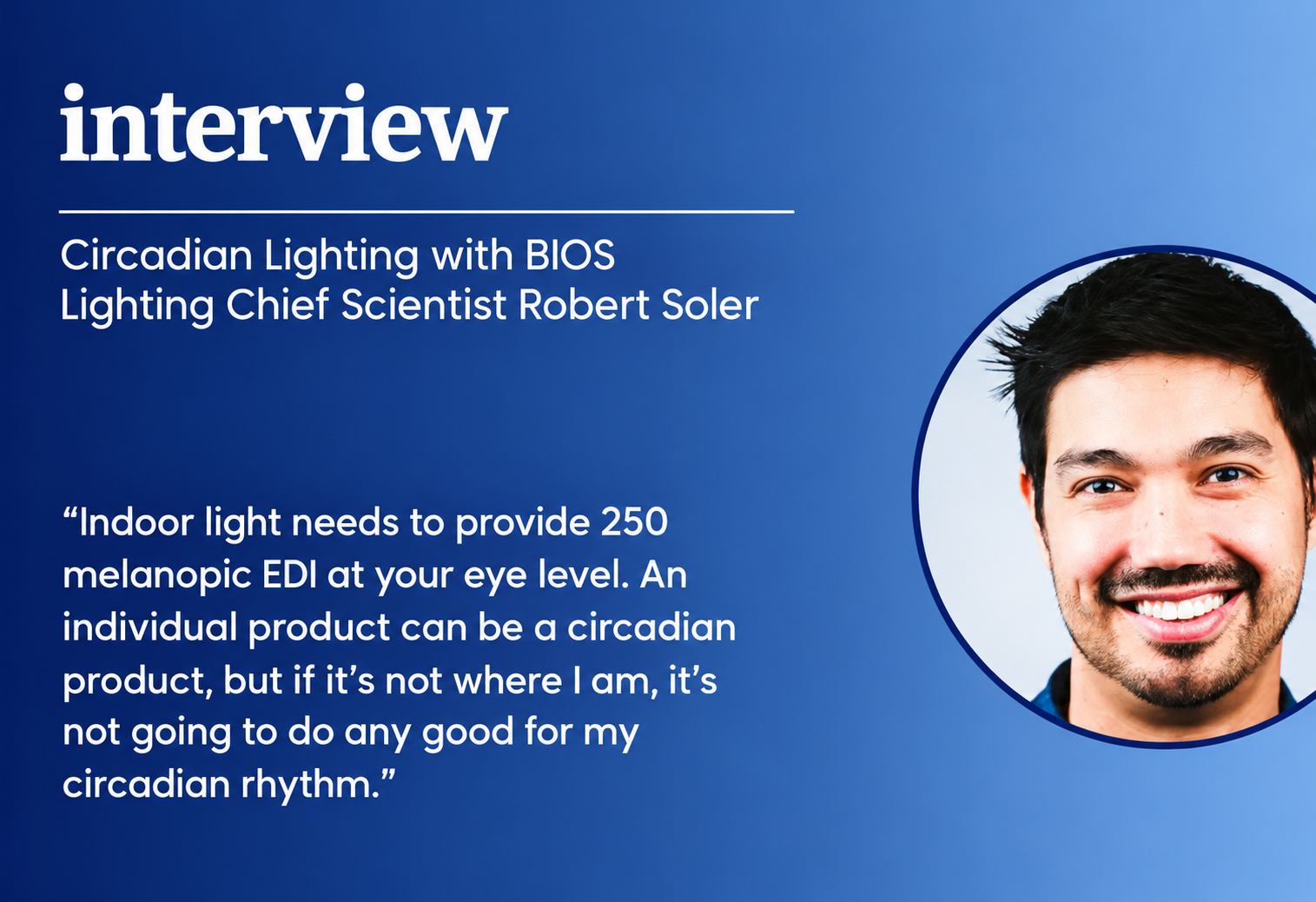
Because the founder and chief scientist of BIOS Lighting, Robert Soler has spent a lot of his profession translating circadian science into sensible lighting steerage. His work contains NASA, elite sports activities organizations, the Worldwide WELL Constructing Institute, and the Nationwide Institutes of Well being. In a current dialog with Interiors+sources employees author Lauren Brandt, Soler explains why reaching biologically efficient lighting requires designers to suppose past the luminaire—contemplating daylight, house planning, occupant habits, controls, visible consolation, and vitality use as a part of one built-in technique.
Wish to be taught extra about circadian lighting? “Product Talk” Podcast Episode.
Circadian lighting and daylight
i+s: Circadian lighting generally is a complicated factor to include into your inside design. Do designers typically oversimplify or misunderstand circadian lighting?
Robert Sorrell: I feel what they’re oversimplifying is how a lot daylight can contribute. You would possibly suppose, “This house has a number of daylight and plenty of home windows, so it is in all probability going to help my circadian rhythm nicely.”
We now have an indicator and normal: melanopic EDI. The required melanopic EDI throughout the day is 250, within the night lower than 10, and at evening lower than 1. The place to measure is the attention space, not the duty airplane.
If in case you have good window entry, you have to be inside 5 ft of the window to acquire 250 melanopic EDI. The second your physique turns away from that window, you may get about half of that.
The problem from a designer’s perspective is that home windows are virtually at all times on the other aspect of doorways. You might be asking somebody to face the window and their again to the door. It typically faces a wall with a window on one aspect and a door on the opposite. We have repeated our measurements and utilizing that aspect window utility you may in all probability get about 40% of the blue-sky reference you want.
What makes lighting biologically efficient?
i+s: What’s the distinction between biologically efficient lighting options and merchandise bought merely as “circadian”?
Sorel: It is dependent upon the appliance. Indoor gentle ought to present 250 melanopic EDI at eye degree. Particular person merchandise can have an effect on my circadian rhythm, but when it isn’t the place I’m, it does not do something for my circadian rhythm.
There should not solely visible standards, but in addition physiological standards. Most ceiling lights are designed to shed gentle onto the duty airplane beneath. It is not very environment friendly at letting gentle into your eyes. Software is vital to offering efficient organic illumination.
If a product claims to offer circadian lighting, ask, “How does it must be utilized to fulfill that normal?” Take a look at the spectrum, melanin pigment ratio (MDER), and utility steerage. rule of thumb is that you really want MDER to be better than 1.
Indoor vertical melanopic gentle measurements from two viewing instructions via a transparent east window (WWR=49%, head peak 6’8″), window view (orange) and window 90 diploma wall view (inexperienced) at 1.2 m peak beneath clear midday situations in Carlsbad, CA. Blue line signifies beneficial indoor melanopic gentle publicity threshold. Picture courtesy of BIOS Lighting.
Integration of daylight and electrical lighting
i+s: How ought to daylight and electrical lighting be mixed in an area?
Sorel: Designers who do that nicely perceive human habits. Automation is essential as a result of in the event you management the shades manually, when you shut them, it’s possible you’ll not be capable of open them once more.
Daylight is essential for biophilia, vitality effectivity, and plenty of different issues. However it’s kind of short-sighted to suppose that circadian checkboxes are robotically checked.
Electrical lights should help the performance of the home windows. Will the lights cowl me after I look within the different course? We want lights to help our design narrative, our connection to nature, and the advantages that daylight brings to us, whereas guaranteeing that gentle hits your entire house equitably, regardless of the place you sit, the place you face, or the place you’re within the constructing.
Balancing automation and crew management
i+s: How can designers steadiness automation and occupant management?
Sorel: Should you request people to vary the lighting between day and evening, they’ll by no means do it. That half must be automated. However you possibly can’t merely reproduce what’s taking place outdoors. For instance, in the event you’re in Boston within the winter and your lights go to “sleep” mode at 5pm when you may have a deadline, it will not help folks or the exercise within the house.
I sometimes advocate 7am to 7pm as daytime, after which I could fade into night mode. Nevertheless, I would like the flexibility to override that. Somebody has to have the ability to say, “I am not prepared for that but,” and press a button to change it again to daytime mode for a sure period of time.
One of many greatest obstacles to circadian lighting has been the management gear, which is complicated to put in and fee, and costly, solely to seek out that finish customers do not know how one can use it. Please maintain it so simple as attainable.
Biologically efficient gentle and visible consolation
i+s: How can designers present biologically efficient gentle with out compromising visible consolation?
Sorel: It is one of the crucial tough issues. If glare just isn’t addressed, it may undermine your entire worth proposition. Dimension and distinction ratio are essential. The smaller the sunshine supply, the brighter it will likely be. When a wall displays gentle, it isn’t as shiny as a result of it is distributed over a a lot bigger floor.
You possibly can set up lighting that improves efficiency and vitality ranges, however while you ask folks whether or not they need that lighting or hotter, extra comfy lighting, they virtually at all times select comfy lighting. If you would like folks to get pleasure from your house, your lighting must examine the glare field. In any other case, the that means of what you are doing can be diminished.
well being and vitality effectivity
i+s: In what methods do well being and vitality effectivity objectives help or contradict one another?
Sorel: Historically, the main target has been on offering sufficient gentle to fulfill visible requirements with minimal vitality. Subsequently, the spectrum and distribution of illumination has little organic influence.
We’ve to get smarter in regards to the effectivity of our functions from a well being and wellness perspective. The sunshine that hits your process airplane is the sunshine that you just see, however the gentle that hits your face is the sunshine that you just really feel. How can we take care of these two successfully and independently?
Daylight is one place the place well being and sustainability coincide. But when sustainability is measured in lumens per watt and also you want 90 foot candles to achieve your well being objectives, you are lacking the purpose. Should you can obtain well being at round 0.4 watts per sq. foot, you have efficiently mixed the 2.
How inside design selections have an effect on circadian efficiency
i+s: What different inside design selections can influence circadian efficiency?
Sorel: Supplies are fascinating. Mass timber absorbs a whole lot of sky blue gentle, so it does not distribute the sunshine nicely all through the house. The identical goes for inexperienced leaves, which replicate inexperienced and soak up blue and crimson.
Subsequently, one thing that’s biophilic can also be inconsistent with this facet of well being. We have to contemplate the explanations for designing an area, comparable to collaboration, social interplay, and reference to nature, however organic necessities should even be met.
In the end, ask how residents are utilizing their house. Is it primarily a daytime exercise house or is it a spot the place folks sleep? Shift work is a unique animal as a result of schedules are essential. Lighting options ought to help occupant operate and why persons are within the house within the first place.
In regards to the creator
Lauren Brandt Each are employees writers. inside + sauce and constructing. She is an award-winning editor and reporter whose work has appeared in each day and weekly newspapers. She holds a bachelor’s diploma in journalism and media communications from Colorado State College Fort Collins and a grasp’s diploma in organizational administration from Chadron State College.
Supply and copyright: It was first printed inside + sauce October 13, 2026. Written by Lauren Brandt. Republished on LED Skilled with permission.
Learn the unique article: How designers plan biologically effective light