


Sensible glasses are broadly tipped to observe the smartphone and the good watch as the subsequent on a regular basis machine. In a weblog submit revealed by ams OSRAM on 17 November 2026, David Gamperl, Product Supervisor for CMOS options for AR good glasses on the firm, describes how digital photonics makes secure eye monitoring, correct coloration sensing and shiny micro-displays attainable in new AI and AR glasses designs. LED skilled reproduces the textual content under, evenly edited.
Secure eye monitoring, correct coloration sensors and shiny micro-displays make new AI and AR glasses designs attainable
Digital photonics at a look
Digital photonics combines mild sensors, mild emitters, energy and logic in extremely built-in, application-oriented methods. In good glasses, these applied sciences help eye monitoring, coloration sensing and near-to-eye shows, with ams OSRAM offering parts and system experience throughout the optical stack.
After the smartphone and the good watch, good glasses are actually many observers’ guess to turn out to be the brand new heart of customers’ digital lives, the machine that they use all day to find, file, and interpret their world.
To see and perceive the world, and render details about it in entrance of the person’s eyes, good glasses are utilizing more and more refined optical expertise for sensing, illumination and interfacing. Probably the most thrilling advances are within the area of digital photonics, the extremely built-in chip-scale methods which mix mild sensors, mild emitters, energy and logic in an application-oriented bundle. These are core capabilities of good glasses, and ams OSRAM gives experience and expertise throughout the whole optical stack.
Because of its lengthy collaboration with the main producers of good glasses and its deep understanding of their designs, ams OSRAM has developed a variety of optimized options for the subsequent era of good glasses. Digital photonics is enabling useful capabilities reminiscent of secure eye monitoring, true-color digicam imaging, and shiny, high-resolution picture output at low energy in near-to-eye shows. This superior optical expertise gives a key to the event of recent forms of good glasses.
Digital photonics expertise is on the coronary heart of the performance of next-generation good glasses (Picture: ams OSRAM)
AI makes good glasses smarter
Sensible glasses are evolving quick. The primary units operated primarily by means of a voice interface to reply queries and deal with messaging and voice communication.
At present, the product is morphing into new varieties: AI glasses present an always-on connection to an agentic AI service, with context-aware data voiced in audio and/or rendered as an data overlay on a mono-color or RGB near-to-eye show. Much more refined than this, AR (augmented actuality) glasses can do all of the above but in addition generate visible artifacts which might be locked to the actual world reasonably than to the person’s gaze, reminiscent of a rendering of a favourite celeb who stays seated subsequent to the person regardless of which a part of the room the person is taking a look at. To allow options reminiscent of this, AR glasses embrace a high-brightness, high-resolution near-to-eye micro-display for the AR graphics, in addition to for rendering high-quality images and streaming media.
The necessities for the optical expertise embedded in these new merchandise, whether or not AI or AR glasses, are the identical:
- To optimize energy utilization, enabling a smaller, lighter battery to help day‑lengthy operation between prices.
- To avoid wasting area and scale back weight, in order that designers could make trendy, comfy frames with out cumbersome parts compromising the look.
- To draw customers with useful performance which simply works, intuitively and unobtrusively.
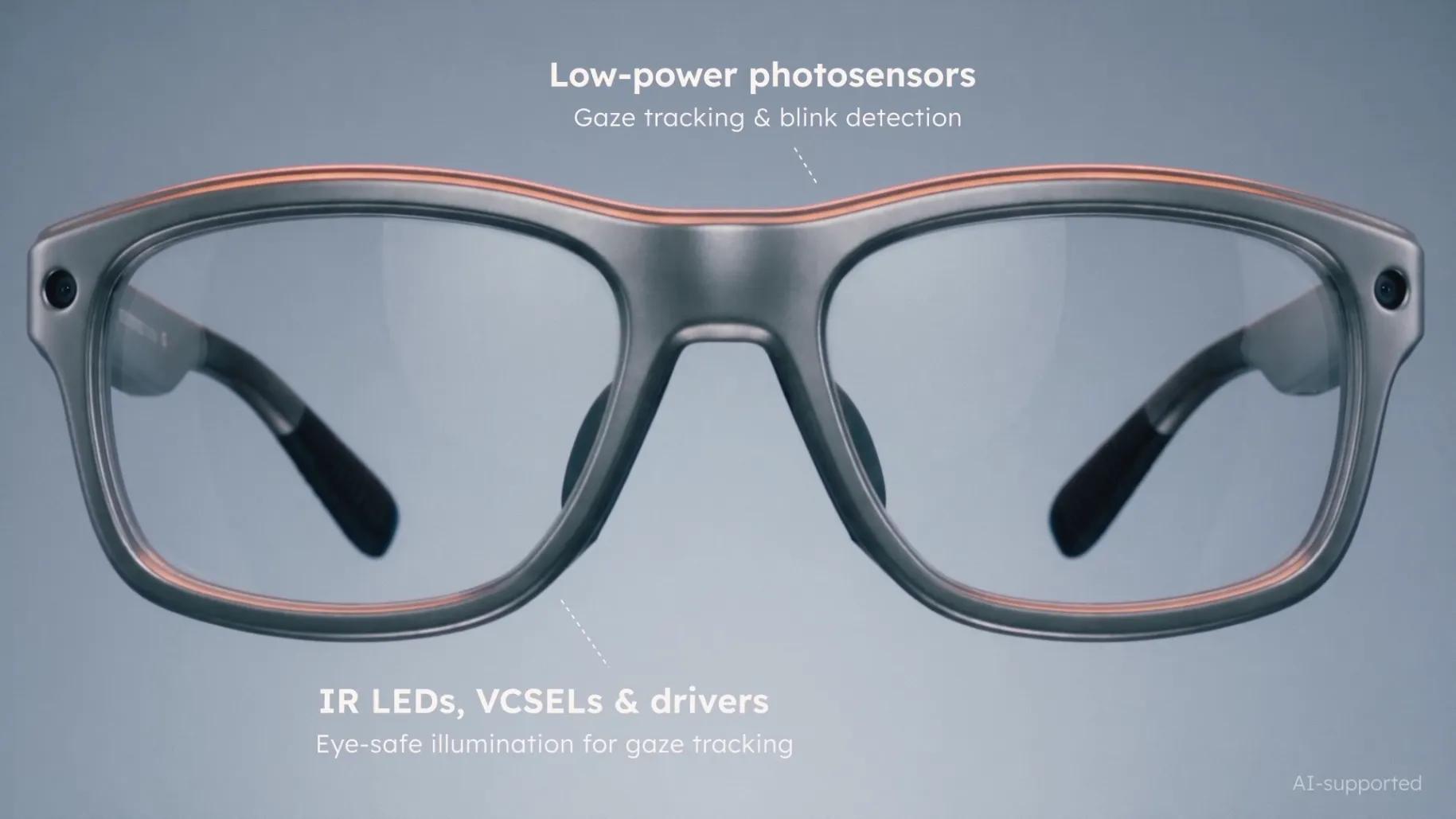
One notable instance of the potential of digital photonics to enhance performance is secure eye monitoring – expertise which makes use of tiny LEDs contained in the body to detect the path of the person’s gaze.
How can built-in eye-tracking security capabilities save area and simplify design?
Area saving and person security are prime priorities for good glasses producers. This makes ams OSRAM’s digital photonics experience notably useful for eye monitoring. It is a core perform of AI and AR glasses, because it gives:
- Premium performance – eye monitoring permits the glasses to find out the place the person’s eyes are centered, and to current related data which is conscious of the context. For example, when a client is taking a look at a meals shelf in a grocery store, the glasses know which product has attracted the person’s curiosity, and may present details about its dietary content material. In a restaurant abroad, the glasses can see which a part of the menu the person is taking a look at, and present a translation of simply that half.
- Energy saving – when the glasses know the place the person is trying, they will present a pointy, shiny micro-display output in simply that a part of the in-lens show, lowering the decision and dimming the image on the periphery. This protects vitality by decreasing the ability used to light up the show, and by scaling again the work executed by the graphics processor to render content material on-screen.
Invisible mild from low-power infrared LEDs illuminates the eyeballs, permitting their motion to be tracked by an IR digicam (Picture: ams OSRAM)
Eye monitoring works by illuminating the eyeball with a number of low-power infrared LEDs. A digicam going through the attention tracks the reflections as the attention strikes left and proper, and up and down. Algorithms calculate the path of the person’s gaze from the digicam’s output.
Eye-tracking methods use low-power infrared LEDs and are designed to function in compliance with worldwide eye-safety requirements reminiscent of IEC/EN 62471 and IEC 60825-1. As a result of the emitters are situated near the person’s eye, producers should make sure that the optical output stays inside outlined eye-safety limits underneath all working circumstances. The requirements require consideration of faults, reminiscent of failures within the electrical or optical parts.
Producers can comply by implementing a dependable methodology for limiting the present that may be equipped to the LEDs, and consequently limiting the quantity of sunshine that they will emit. A discrete over-current safety (OCP) swap might be inserted between the ability provide and the LEDs. If a fault within the energy provide lifts the drive present above a secure threshold, the OCP studies the fault to the appliance processor, which then triggers the OCP to close off the present, in order that the LEDs go darkish.
Typical eye security safety circuit with exterior, discrete OCP swap (Picture: ams OSRAM)
A extra superior answer now accessible from ams OSRAM integrates the protection safety perform into the LED driver. The AS1181 driver, which gives eight 65 mA LED channels, is completely matched to ams OSRAM infrared emitters for eye monitoring, such because the SFH4030B, simplifying system integration whereas guaranteeing dependable and constant efficiency.
Housed in a small 2.85 mm x 1.7 mm WLCSP bundle, the AS1181 consists of an built-in monitoring circuit which detects fault occasions reminiscent of over-current, open circuit and quick circuit. The AS1181’s inside swap shuts off the present to the LEDs on detection of a fault.
The AS1181 built-in security driver is less complicated to combine and requires fewer parts (Picture: ams OSRAM)
By utilizing the AS1181 as an alternative of a circuit based mostly on an exterior OCP machine, eye monitoring system builders can:
- Simplify the system – the AS1181 integrates LED fault monitoring and automated shutdown, eradicating the appliance processor from these safety capabilities. Integrating these capabilities can get rid of the necessity for a discrete OCP swap, decreasing element depend and board footprint, and simplifying the board format.
- Enhance efficiency and security – the AS1181 runs a built-in self-test (BIST) routine at every start-up to test for proper operation. It performs steady monitoring of temperature and LED faults. Monitoring of LED ahead voltage at every channel permits the ability provide to be adjusted to compensate for voltage drift over time and temperature. This ensures that secure LED brightness is maintained, for constant eye monitoring system efficiency.
These built-in safety capabilities help system design; compliance with the relevant eye-safety requirements should nonetheless be assessed for the whole finish machine.
Design blueprint for speedy implementation
Sensible glasses producers can speed up the product improvement course of by adopting a ready-made design template for secure eye monitoring. Ganzin Expertise’s Aurora IIS eye monitoring reference design combines the AS1181 driver IC with SFH4030B LEDs to allow dependable eye monitoring even outdoor in shiny daylight. The reference design options synchronized binocular digicam driving, complemented by extra driver-based eye security safety within the AS1181. This answer powers Ganzin’s AI glasses reference designs, and is able to allow next-generation companion platforms, reminiscent of these from Ganzin’s ODM companions together with Jorjin and Quanta.
Equally, SeeTrue Applied sciences provides a wise glasses eye-tracking platform based mostly on ams OSRAM infrared illumination expertise, exhibiting how miniature IR emitters can allow exact and dependable gaze detection in next-generation AI eyewear.
How does digital photonics help imaging and shows in good glasses?
Moreover eye monitoring, digital photonics expertise helps varied different vital capabilities in AI and AR glasses.
For example, superior coloration sensors, which give an correct digital illustration of ambient mild, can carry out tamper detection of the privateness mild, serving to detect whether or not it’s blocked when the digicam is working. A multi-channel mild sensor can detect the colour of ambient mild, to allow automated adjustment of the show’s coloration stability and brightness, in addition to the shade of transition lenses when uncovered to shiny mild.
Flicker and brightness measurement additionally permits automated adjustment of digicam publicity, whereas the most recent spectral sensors for cell functions enhance picture coloration correction and automated white balancing, supporting constant colours and improved picture high quality in footage taken by good glasses.
Optical sensors embedded elsewhere within the body can present quite a lot of different helpful inputs: biosensors, as an illustration, can monitor important indicators reminiscent of coronary heart fee, and UV sensors can measure publicity to daylight, whereas direct time-of-flight sensors can detect person management gestures, and supply put on detection. Miniature optical power sensors flip the floor of the body right into a person management interface, eliminating the necessity for mechanical buttons.
Excessive-resolution near-to-eye micro-displays are a central characteristic of the brand new AR glasses: micro-emitters for projection shows are rising as a beautiful expertise answer. ams OSRAM’s MicroLED expertise is designed for environment friendly energy utilization, excessive brightness and exact angular decision – key necessities for light-weight AR glasses, outside use and a pure area of view. MicroLED-based projection mild engines from ams OSRAM can subsequently help clearer pictures and longer working time with a smaller battery.
Different approaches to projection shows make the most of ams OSRAM’s miniature built-in RGB LED or laser modules for AR micro-displays, backed by complementary customized driver ICs.
Digital photonics experience helps transfer good glasses design ahead
ams OSRAM brings digital photonics and methods experience collectively to enhance the efficiency and effectivity of optical methods within the subsequent era of good glasses. As these units turn out to be extra compact and comfy, with superior capabilities that function longer on battery energy, this mixed experience performs an vital position in attaining these enhancements.
The unique submit additionally features a quick video on eye monitoring parts in good glasses: watch it on YouTube.
Concerning the writer
David Gamperl is a Product Supervisor at ams OSRAM centered on CMOS options for next-generation AR good glasses. With 18 years of expertise within the semiconductor trade, his experience spans show options, LED drivers, energy administration ICs, and optical sensing applied sciences for extremely built-in wearable methods. He works on the intersection of product technique, expertise innovation, and buyer functions to deliver superior AR options to market.
Supply: Digital photonics: augmenting the value of smart glasses, ams OSRAM weblog, David Gamperl, 17 November 2026