

This text by Octavio L. Pérez, Ph.D, FIFA Permitted Floodlights Technician and Integrative and Sports activities Lighting Analysis Scientist & Advisor, is the second a part of his sequence on illuminance measurements in sports activities lighting, written for LED skilled Evaluation (LpR) in 2026. Half I coated the illuminance meter and its limitations.
In a earlier article we reviewed the illuminance meter (luxmeter) and its limitations in sports activities lighting illuminance evaluation. That article was extra associated to the technicalities and fundamentals of the instrument.
On this piece, we’ll evaluate the purposes of the luxmeter within the subject, in sports activities lighting, and the way the accomplishment of various measurements (horizontal, vertical, digital camera) has completely different approaches – one doesn’t match all.
Even when illuminance is the measurand of alternative, now we have to bear in mind its limitations, as eyes and cameras understand luminance, that’s extra complicated to measure and consider.
Illuminance in sports activities lighting – horizontal (Eh) and vertical (Ev)
We now have two (2) most important illuminances to evaluate in sports activities lighting, notably for soccer/soccer:
- Horizontal (Eh)
- Vertical (Ev)
Within the case of vertical measurement of illuminance (Ev), now we have to tell apart between two most important approaches:
- Orthogonal Planes associated to the play space (PA): Ev_00, Ev_90, Ev_180, Ev_270
- Digicam Planes (measurement planes regular to the cameras)
Concerning the heights, following worldwide requirements, resembling EN 12193 (Europe) and AS2560 (Australia), Eh is taken at floor degree and Ev at 1.5 m (identical as for glare calculations) with some exceptions.
The rationale for these standards is sensible. Within the case of Eh, that is the illuminance that reaches the playground, the floor that the cameras are going to seize, and the ball and boots within the case of sports activities resembling soccer/soccer. For Ev, it’s the common peak of the higher aspect of the physique and arms of the gamers. Take into consideration the variations between sports activities resembling soccer/soccer and basketball.
There are non-public requirements that do each measurements (Eh and Ev) on the identical peak, based mostly on causes of practicality. Fairly than doing one move at floor degree and one other move at 1.5 m, it’s a lot simpler, and cheaper, to do a single move at 1 m. The practicality justification is that Eh at floor degree and Eh at 1 m don’t differ “considerably”, assumption that’s essentially mistaken, getting actual variations within the sidelines (Ehg Eh1 m) and in the midst of the sector (Ehg > Eh1 m).
As a “curiosity”, even when it is a disregarded element in sports activities lighting, we even have to think about that simulations (“Modelled Efficiency”) are calculated assuming that the pitches are flat. This may be the scenario for indoor areas, however undoubtedly not for out of doors pitches. Relying on the climate/rain and drainage techniques, out of doors pitches can have slopes that may have an effect on the lighting, with peak variations between the middle and the perimeters of the pitch (“crowning”). However, that is out of the scope of this text.
Let’s go deeper on every of the illuminances (Eh and Ev) earlier than coming into into automation/robotics particulars.
Horizontal illuminance at floor degree (Ehg)
Horizontal illuminance measurement is the historic basis of sports activities lighting.
The most important intention of Eh is to evaluate the uniformity ranges that attain the taking part in floor (floor). Components such because the reflectance of the bottom materials play a important position, and we are able to find yourself seeing darkish spots in locations of most illumination, because the “brightness” that we understand will not be illuminance however luminance (mirrored gentle). However, luminance measurement has its personal complexities, and Eh evaluation has been in place for years, performing as an appropriate “proxy”.
The measurement of horizontal illuminance (Eh) at floor degree (Ehg), is among the extra hated ones by operators. The explanations are straightforward and comprehensible:
- First, it’s about ergonomics: it’s worthwhile to lean ahead to place the instrument on the bottom. At one level nothing to fret about, however when it’s important to do it round 100 instances, at night time, in a moist setting, your again will begin to resent it.
- Second, correct leveling of the instrument. It is vitally straightforward in indoor surfaces, resembling basketball courts, and a bit difficult while you go into grass surfaces, and much more on pure grass. The orientations of the grass fibers can take the instrument out of degree, and options resembling a plates are wanted to make sure correct leveling of the meter.
- Third, distancing from the measurement. With a purpose to keep away from interfering with the studying, it’s worthwhile to transfer away from the instrument.
The impact of f2 (cosine issue) that we mentioned within the earlier article has minor influence in Eh on the sidelines (with a close to perpendicular angle of assault from the fixtures) vs on the center of the pitch the place the angles can turn out to be substantial, notably with decrease heights of the fixtures constructions (poles), coming into the cosine regulation into (destructive) impact.
Vertical illuminance – orthogonal planes (0º, 90º, 180º, 270º)
Orthogonal planes are comparatively straightforward to deal with, notably on rectangular pitches. The primary reference 0º is often one of many lengthy sidelines (‘01’-‘12’ within the case of FIFA/UEFA). From there you get the opposite ones rotating clockwise ninety levels to get 90º, 180º, and 270º. There are three fundamental approaches for this mission:
- You probably have solely one meter, you’ll need to do 4 (three + 1) rotations (0º, 90º, 180º, 270º), this implies 4 uncertainties associated to orientation, and just one to the instrument.
- Having two meters makes life simpler. Beginning with one meter at 0º and one other one at 180º on a supporting construction, a single rotation (really two as it’s important to return to 0º) saves time and reduces orientation uncertainties, but will increase uncertainties with the meters, as we now have two in motion.
- 4 meters to catch the illuminance within the 4 orthogonal planes directly is the best one when it comes to operation as no rotation is required. Right here, the place of the 4 meters within the supporting head is important, and after you have it, nothing must be modified. The one problem is to degree and intention correctly at every level, that was additionally within the earlier ones. The primary drawback is the 4 uncertainties of the 4 meters, that should be thought-about individually. And this additionally means 4 calibrations somewhat than one.
Illuminance to cameras (Ecam)
Ecam provides complexity to the evaluation. One of the vital demanding requirements is the one from “LaLiga” in Spain, a non-public commonplace the place Ecam shall be taken towards (regular to) 4 (4) reference cameras all around the pitch: grasp, reverse grasp, and objectives (objectives measurements are taken just for half pitch) (Determine 1).
Determine 1: Measurement geometry with 4 reference cameras: Ecam in direction of grasp and aim cameras, Eh and Ev at a grid level (left); measuring heads at a nook of the pitch (proper). (Picture: Octavio L. Pérez)
Because of this working with a couple of (1) sensor will not be a bonus anymore, because it was the case for orthogonal Ev. Right here, on every level, now we have to intention the sensor at every of the 4 (4) cameras. The azimuth (absolute and relative) and elevation change, and no static sensor association solves the scenario.
Measurements automation
We beforehand mentioned the necessity to automate the readings from the luxmeters, and right here we’ll talk about automate the pitch evaluation, the mission.
Automated studying from the meter is a should. Contemplate the FIFA-96 factors grid plan, with 5 readings per level (Eh + 4xEv), this implies 480 readings, within the subject, at night time, with humidity and low temperatures – 480 alternatives for failure.
And automation doesn’t cease there. The entire course of could be improved and reengineered. Let’s go there.
The grid
The primary automation has to occur associated to the grid plan. In soccer/soccer, essentially the most demanding measurement grid plan is the FIFA-96, with 96 factors masking the 4 sidelines. On common, manually measuring the pitch and marking the 96 grid takes between one hour and ninety (90) minutes.
“If” there’s good GNSS/GPS protection on the pitch, marking could be quick. Strolling the lengthy sideline takes round 80 seconds, and 50 for the quick ones (for a median 105 x 68 meters soccer/soccer pitch). Doing the mathematics (80 x 8 + 50 = 690 seconds of strolling + 10 per level for marking) takes you down from 90 minutes to round half an hour, this implies one hour much less. This requires a RTK (“Actual Time Kinematics”) GNSS (“World Navigation Satellite tv for pc System”) with native real-time NTRIP corrections, and an skilled technician.
The density of the grid (quantity and factors distribution) can also be going to have an effect on the evaluation. Determine 2 exhibits the identical subject with a French FFF_25 grid plan. The primary threat of this simplified grid, used for low classes and/or coaching pitches, is that engineers design towards the grid for compliance, notably a budget producers, and the pitch lighting results in a large number even when the lighting design complies with the usual.
Notice that the FFF_25 grid (maillage) plan consists of ten (10) security factors, in pink, to test that the lighting ranges within the outer aspect of the sidelines have at the least seventy 5 p.c (75%) of the illuminance of the neighbor factors. Right here solely Eh at floor degree is assessed.
Determine 2: The French FFF_25 grid plan on a stadium pitch, with the ten security factors outdoors the sidelines in pink. (Picture: Octavio L. Pérez)
Grid path/routing
And right here is the following level. Once more, “if” GNSS protection is nice, now we have the choice to transfer the measuring system with a robotic and/or a drone.
Determine 3: Grid path/routing. (Picture: Octavio L. Pérez)
Eh automation
For Eh, the rover (terrestrial robotic) is a should. A drone will not be acceptable for floor degree measurements of sunshine. See the photographs of the techniques which have been developed that may carry a number of Eh sensors, with and with out leveling compensation. Eh is kind of straightforward as orientation (yaw) doesn’t have an effect on the measurement, solely the suitable degree (pitch and roll). If degree is a should, because it occurs on pure turf, then compensations mechanisms should be organized, being the best one a motorized (servos) head. With a rover shifting at round 50 cm/sec we’d like round fourty minutes to do the entire grid protection together with the measurement stops and leveling changes. By hand this takes round 45 seconds per level in the perfect case, going as much as round 75 minutes (1h and quarter-hour), plus it’s simpler in your again!
Determine 4: For Eh, the rover (terrestrial robotic) is a should. (Picture: Octavio L. Pérez)
Determine 5: Deliberate path of the rover throughout the measurement grid, lane by lane. (Picture: Octavio L. Pérez)
Ev automation
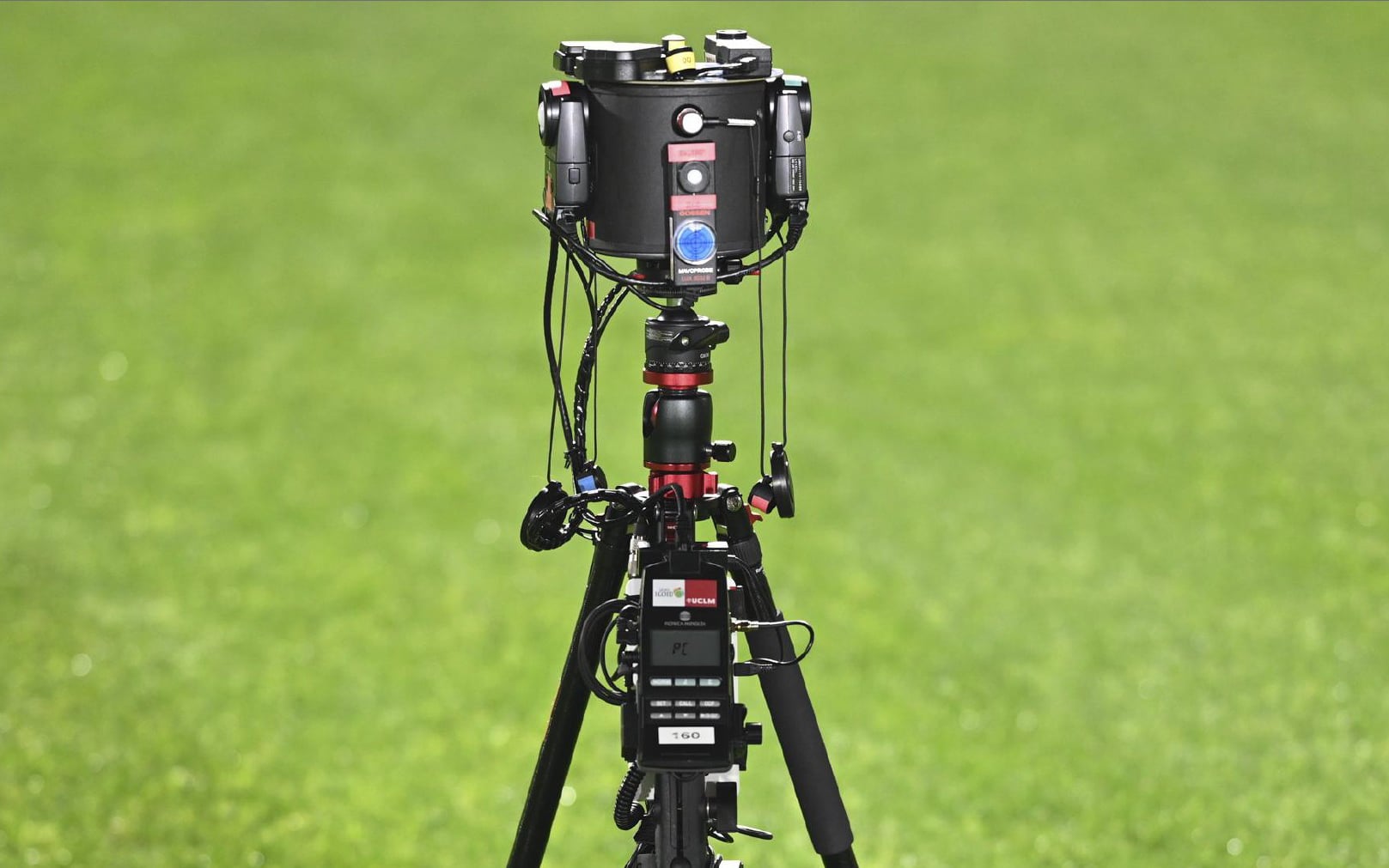
For Ev automations, with the automated system that I assembled for IGOID-UCLM for the FIFA Floodlights Take a look at Occasion in Morocco on 2026-02-12 (Determine 6), with seven (7) gentle sensors, and wi-fi automated acquisition, timing was lowered to a most of 35 seconds between factors (relying on time for leveling) and took round one hour, and I efficiently handed the FIFA Floodlights take a look at occasion for IGOID.
Automating the motion of a rover 1m or 1.5m above the bottom turns into a bit difficult. The inertia {that a} sensor head develops at that peak requires both low pace of the robotic and/or an enormous platform. For this goal, the guide motion of the sensor system is an affordable possibility.
The problem comes with the measurement of Ev at completely different heights, such because the 1m (for FIFA/UEFA), the 1.5m for EN-12193. Measuring solely at one peak will not be due to being essentially the most acceptable, however due to simplifying the surveyor’s work. In earlier instances this might have been comprehensible however right now it’s questionable. Having the drone expertise in place, now we have to review if taking a couple of peak for Ev is sensible as the sport takes place at completely different heights relying on the game. The identical factor occurs with Eh that has been taken at just one peak. Ought to we take Eh on the peak of Ev in order that the modelling index could possibly be evaluated at completely different heights? Take into consideration basketball the place a part of the sport occurs at shoulder heights in comparison with soccer the place many of the recreation occurs at boots peak.
Determine 6: Wi-fi system for illuminance evaluation in sport lighting. (Picture: Octavio L. Pérez)
Ecam automation
For this specific case, Ecam, the creator has developed a patent pending system that robotically factors the sensor (illuminance or spectral) to every of the 4 cameras. Fantastic changes could be made to completely goal the TV digital camera with out human intervention. The system additionally reads Eh at 1.5 m in an effort to estimate the modelling index at every level for every digital camera. On this case, Eh will not be the traditional to the bottom, however the perpendicular to the traditional to the digital camera.
Conclusion
Sports activities lighting is a multidisciplinary artwork and science that highlights the distinction between lighting design and illuminating engineering.
A important half that doesn’t occur in different lighting disciplines besides in disciplines resembling tunnel lighting, highway/avenue lighting and workplace lighting is the considerate evaluation of the lighting supply.
The primary measurand is illuminance, with derived ones resembling uniformity, gradient and modelling.
The meter’s limitations are important and the automation of the studying of the instrument is a should to reduce human errors.
Subsequent step is the automation of the grid ‘stroll’-through. In case of Eh at floor degree, it is a should that may be achieved with a rover. Within the case of Ev and Ecam it is a extra complicated activity as inertia is generated with peak. The automated studying with a full sensor system or robotized one for Ecam is an effective different that saves quite a lot of time.
The lacking one is the drone for Ev, a system that I’ve below growth, with all of the software program already operational.
In our subsequent article, we’ll evaluate the paradigm shift that we’re envisioning, with the event of an entire ecosystem, the place the expert technician doesn’t should be current on the bottom, however monitoring the entire course of remotely in real-time. Keep tuned.
Concerning the creator
Dr. Octavio L. Pérez.
Dr. Octavio L. Perez is a passionate skilled, researcher and scholar who contributes to exploring, creating and bringing to the true world the advantages of sunshine and lighting for human wellbeing and wellness, and in the end, well being. He works internationally as an impartial marketing consultant, centered on translational analysis in human centric lighting (HCL), extra exactly “integrative lighting”. Dr. Perez is a researcher at Mount Sinai Hospital in NYC, NY, USA. and serves in a number of worldwide technical committees. He’s additionally a WELL AP (WELL Constructing Normal Accredited Skilled), focusing now within the difficult subject of lighting evaluation in sports activities venues. And he has began his second Doctorate centered on this subject of lighting (Sports activities), associated to new challenges for Broadcasting necessities and Audit/Survey methodologies.
octavio.perez@lighting.consulting · linkedin.com/in/LightHealth · www.lighting.consulting
Supply: Octavio L. Pérez, “Illuminance Measurements in Sports activities Lighting – Half II, Discipline Evaluation and Robotics”, written for LED skilled Evaluation (LpR), 2026. Extra from the creator: www.lighting.consulting. Pictures: Octavio L. Pérez.