


House Assistant 2026.7! 🎉
That is a kind of releases I’ve been wanting ahead to for a very long time. My favourite by far is what we’ve finished with automations. Goal-specific triggers and situations graduate from Labs and change into the brand new default for everybody. 🎉
It comes right down to one thing we’ve been chasing for years: extra energy, much less complexity. As an alternative of ranging from House Assistant’s internals, which entity, which state, which type of set off, you begin from what you really need your property to do. When the bed room drops beneath 18°C, activate the heating. That’s it. No technical traps, no quirks to memorize. And since integrations can train the automation engine their very own triggers and situations, it solely will get higher from right here. All of it proper there in our lovely person interface.
The good factor is, nothing breaks. All of your current automations hold working, worry-free. We’ve additionally written tons of nice documentation explaining each single set off, situation, and motion, with examples to be taught from. And in the event you’re a kind of individuals who prefers writing automations in YAML as a substitute of the UI, you’re in for an incredible expertise too. Consumer expertise just isn’t a synonym for “the UI”. YAML customers deserve good person expertise too.
However actually? I’ve acquired a second favourite this launch, and that stunned me a bit. Exercise, what a lot of you continue to know because the logbook, has been rebuilt right into a slick and clear timeline. 😍 It reads prime to backside like a feed, teams entries by day, and eventually speaks the identical language as the remainder of House Assistant. I hold opening it simply to take a look at it.
And that’s simply the beginning. There’s a brand new update-all button, devoted panels for infrared and radio frequency, an overhauled ZHA Zigbee system administration, and 10 new integrations from our neighborhood.
Another factor earlier than you dive in: the Open House Basis is exhibiting at IFA Berlin for the primary time, from September 4 to eight, 2026. We’d love to satisfy you there, so come say whats up. There’s additionally a community meetup on Sunday, September 6, and everybody’s welcome. You possibly can read all about it here.
Benefit from the launch!
../Frenck
An enormous thanks to all of the contributors who made this launch doable! And a particular shout-out to @piitaya, @sairon, and @agners who helped write the discharge notes this launch. Due to them, these launch notes are in nice form. ❤️
Creating automations simply grew to become simpler, pure and extra highly effective
That is, palms down, one of many greatest and greatest adjustments we’ve made to the automation editor in years. It has been roughly eight months within the making, constructed and refined launch after launch by lots of people, and formed by a mountain of your suggestions alongside the best way. As of this launch, it’s right here for everybody, and we couldn’t be extra excited to lastly hand it over.
Why are we this excited? As a result of automations have at all times requested you to satisfy House Assistant midway. Some folks nonetheless speak about it such as you want YAML, a coding background, and a free night simply to automate a lightweight. That hasn’t been true for some time, and this launch takes the most important step but towards closing that hole for good.
Again in House Assistant 2025.12, we introduced purpose-specific triggers and conditions in Settings > System > Labs. Each launch since has added extra of them and polished the expertise. This launch, they graduate: this new method of constructing automationsAutomations in House Assistant can help you robotically reply to issues that occur in and round your property. [Learn more] is out of Labs and turns into the brand new default for everybody. 🎉
It’s tempting to learn this as a nicer set of menu choices. It’s far more than that. It’s a totally different place to begin: you describe what you need your property to react to, fairly than ranging from the technical constructing blocks beneath.
Begin with what you need, not the way it works
An automation engine thinks in primitives. Folks don’t. You suppose “when the entrance door opens”, “when the final individual leaves”, or “when a battery runs low”.
The previous path began some other place, with House Assistant’s internals. Which entity? Which state? Does it change into on, detected, house, or not_home? Do I would like a state set off, a numeric state set off, a tool set off, or a system occasion? If you realize House Assistant properly, these questions are second nature. If you happen to don’t, they’re the wall you hit earlier than you even begin. 😤
The brand new triggers and situations converse the language of the factor you care about. When the bed room drops beneath 18°C, activate the heating. You don’t take into consideration numeric state triggers, attributes, or items. You decide Temperature crossed threshold and say what issues. Or Battery low: no have to know whether or not a tool stories its battery as a proportion sensor, or what counts as “low”. You construct across the second itself.
Constructed round areas, not one system or entity at a time
The new building blocks also support targets, and that is a bigger deal than it sounds.
You can build an automationAutomations in Home Assistant allow you to automatically respond to things that happen in and around your home. [Learn more] around motion in the living room, instead of around one specific motion sensor. One sensor in that room, fine. Ten, also fine. Swap one out next year, add another, or remove the one that kept seeing the cat, and the automation keeps describing the same intent: motion in the living room.
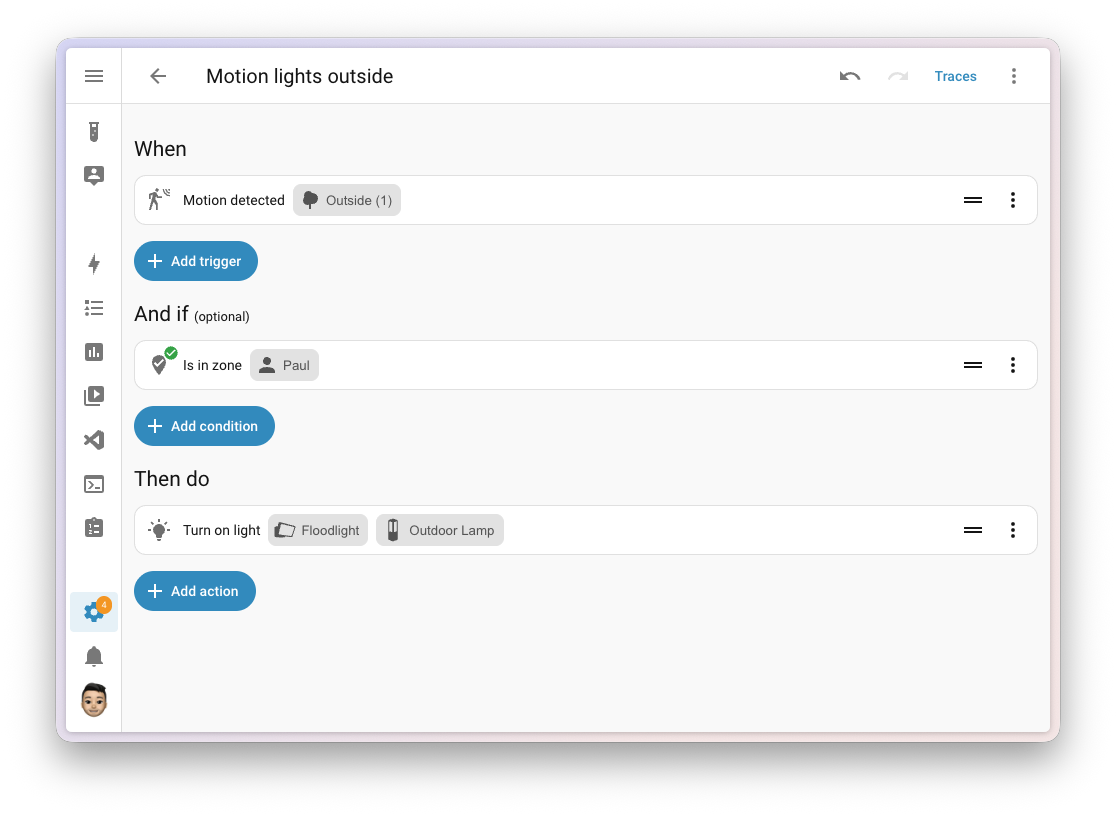
When motion is detected outside, turn on the lights outside. The trigger points at the outside areaAn area in Home Assistant is a logical grouping of devices and entities that represents a room or space in your home, such as the living room, kitchen, or garage. [Learn more], the action points at the outside lights. Change which sensors or lights live there later, and the automation follows along. It reads like a sentence, and it is one less fragile list of entities to maintain forever.
More than friendlier wording
Here is the part that is easy to miss: this isn’t just a friendly wrapper around the old triggers.
These triggers and conditions can be extended by integrationsIntegrations connect and integrate Home Assistant with your devices, services, and more. [Learn more], including custom and community ones. Integrations have long been able to add their own actions; now they can add their own triggers and conditions too. Picture a washing machine integration offering a plain “laundry is done” trigger, with no need to know which state value or attribute actually means finished. An integration knows things you would otherwise have to figure out yourself: which state changes matter, which to ignore, which edge cases are normal, and what a useful automation moment looks like in its world.
A sensor can tell you the electricity price. The integration can tell you when the price is lowest today. Instead of everyone rebuilding the same template, or learning the quirks of one particular heat pump, EV charger, or alarm panel, the integration can offer the triggers, conditions, and actions that make sense for it. That turns the automation engine into something integrations can teach. It is where “more power, less complexity” stops being a slogan.
No technical traps
There is a quieter benefit too: No technical traps. 💪
With these new triggers, you don’t need to care about unknown or unavailable states. The building block handles those in the way that makes sense for its purpose. The moment you have to decide whether one specific automation should ignore unavailable, wait it out, or treat it as false, we have already made you think about the wrong thing.
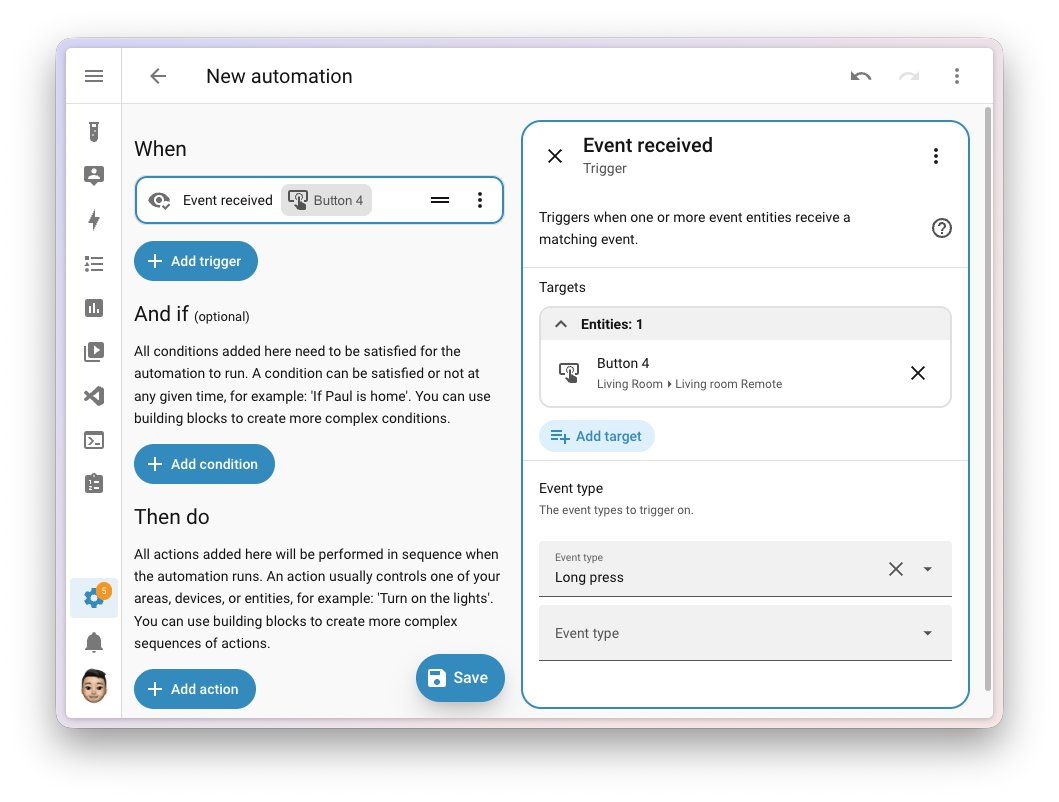
Event entities are another classic. Automate around one with a plain state trigger and you may discover it doesn’t fire the second time the same event happens, because the state didn’t change the way you expected. A purpose-specific trigger expresses the event directly, so that whole class of surprise simply goes away.
Your automations are safe, and YAML isn’t going anywhere
Before anyone opens a forum thread in mild panic: no, you don’t need to rewrite anything.
Existing automations keep working. Generic triggers, conditions, templates, and YAML all keep working. The new triggers and conditions are simply the better starting point for the next automation you build, and a nicer option when you decide to improve an old one. It is not a migration tax.
And this isn’t Home Assistant walking away from YAML. We put real effort into making the new building blocks read well in YAML too, the same way we did when automations moved to triggers, conditions, and actions and swapped service for action. If text is your interface, it should feel just as natural. If you use YAML to write automations, we are sure you’ll love the new triggers and conditions just as much!
Documentation is part of the feature
We also did the less flashy work, which on a project like this is often the work that matters most. Every trigger, condition, and action now has its own documentation page over at triggers, conditions, and actions. Each one explains what the building block is, when you would reach for it, how to use it from the automation editor, how it looks in YAML, and includes real examples to learn from.
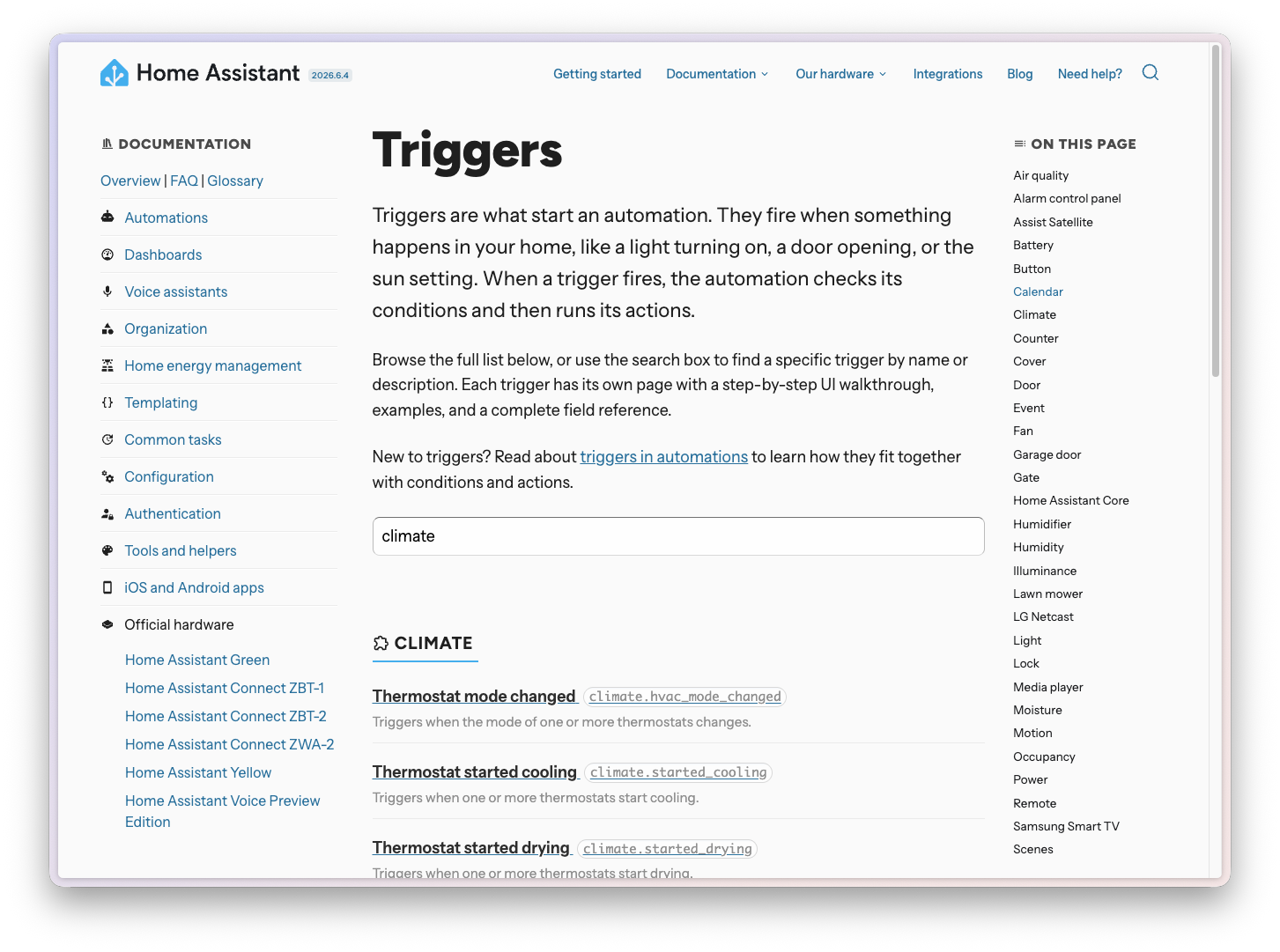
There is a lot of it, on purpose. Approachability is not only about a friendlier button in the UI. It is also about helping you understand what that button does, and when to use it. Good documentation is product work, even when it does not get its own screenshot.
There is an AI angle here too, and it belongs in the right place: this is for people first. But many of you already use AI to help build automations, and clearer, well-described building blocks give those tools much better material to work with. Their suggestions can become more consistent, because there is less Home Assistant-specific guesswork to invent. It will not happen overnight, since most models are trained on older examples and may keep suggesting the old patterns for a while. The better the documentation, the faster both people and machines pick up the new way.
Haven’t tried building automations this way yet? Open the automation editor and start with what you want to happen. We think you’ll like where it begins. 😎
Activity logbook
Activity, the feature many of you still know as the logbook, has always been there to answer a simple question: what happened, and when? The way it answered, though, was a flat list of full sentences. “Living room lamp turned on.” “Auto lights was triggered by motion.” Every row was a complete sentence, the device name was repeated on every line, and it used its own wording (“turned on”, “changed to”) that didn’t quite match how states are written everywhere else in Home Assistant. Reading back a busy day meant reading every single line.
This release rebuilds it from the ground up into a timeline.
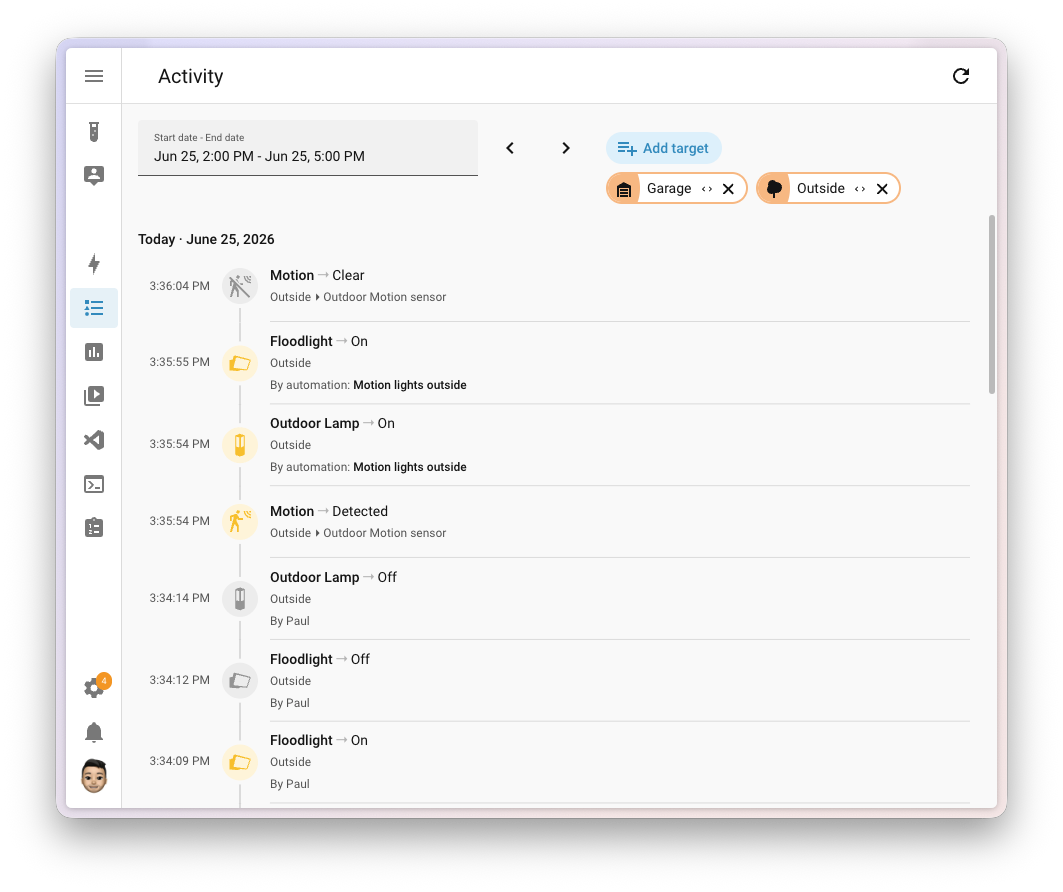
Each entry now sits on a vertical rail: the time on the left, a colored dot with the entityAn entity represents a sensor, actor, or function in Home Assistant. Entities are used to monitor physical properties or to control other entities. An entity is usually part of a device or a service. [Learn more]’s icon, and the text beside it. You read it top to bottom, like a feed. Entries are grouped by day, with Today, Yesterday, and dated headers, so you never lose track of where you are in time. The dot takes on the state color too, so an on and an off are easy to tell apart at a glance, without reading a word.
It also shows only the context you actually need. The timeline trims the name down to where you’re looking: on an entity page you just see the value, on a device page the device name is dropped, and on an area page the area is left out. No more reading the same device name on every row.
A few more touches make it feel right at home:
- The same words as the rest of the app. State text now comes from the backend, the same source the rest of Home Assistant uses, so it reads identically everywhere and in every language. No more logbook-only verbs.
- It shows the cause. When something was set in motion by a person, you see their avatar. An automation shows what triggered it, and an integration shows its brand icon. The “why” sits right next to the “what”.
- Time the way you want it. In the compact views, like the more info dialog, device and area pages, and on cards, select the timestamp to flip between absolute time and a relative “2 hours ago”. A quick glance when you want it, exact precision when you need it.
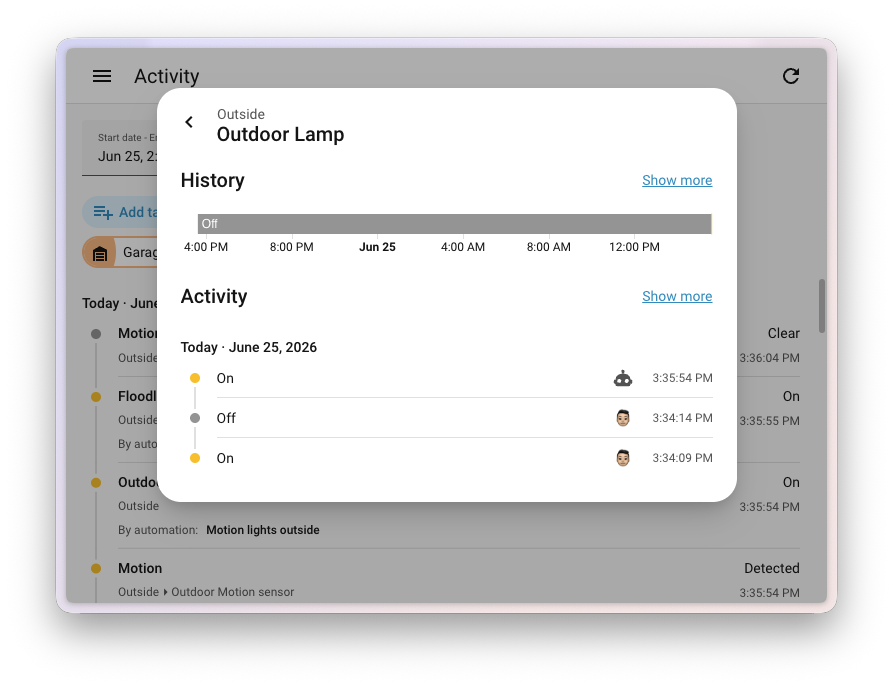
The same component powers all of this, so the timeline stays consistent whether it’s filling the full Activity page on a wide screen or tucked into a card on your phone. Wide screens get the full timeline with the time column and icons; narrow screens and cards get a compact version with the cause icon and the time trailing the entry.
Update all
We’ve all been there. You open Settings > Updates after being away for a bit, and there it is: a wall of pending updates. A new Home Assistant release, a handful of apps, that one integration, and seven ESPHome devices that all decided to ship new firmware in the same week. Keeping up used to mean working down that list one entry at a time, selecting, waiting, selecting the next, and repeating until your finger got tired.
Not anymore. This release reorganizes the updates page around how you actually think about your system, and adds a single button that does the heavy lifting: Update all.
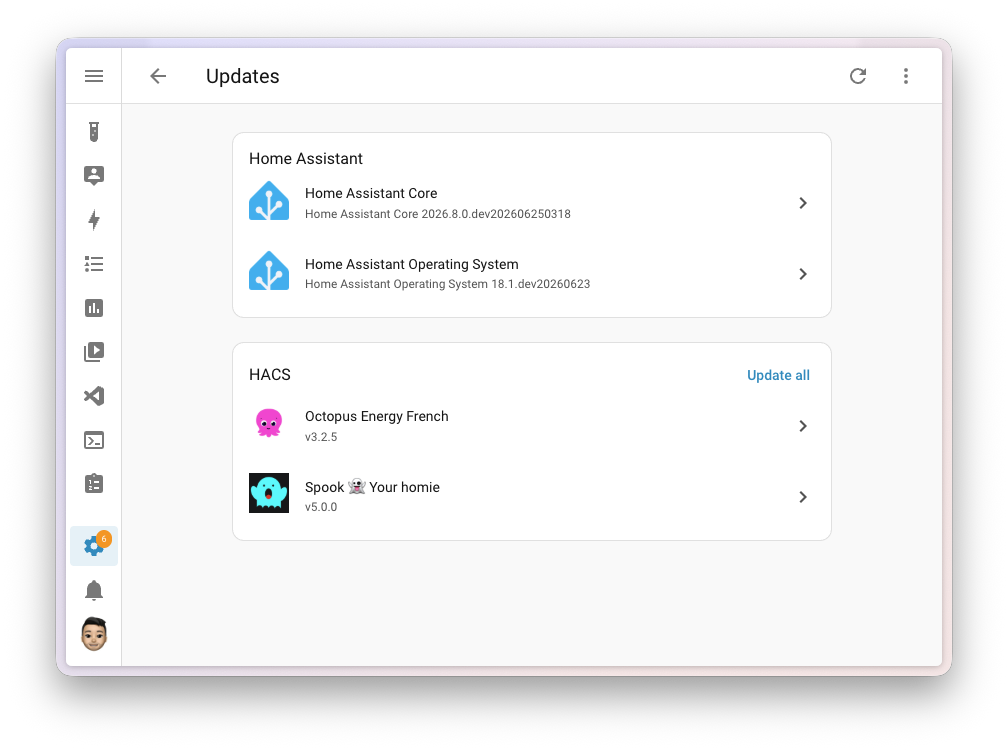
Instead of one long, flat list, your pending updates are now grouped into clear cards, each covering a part of your setup:
- Home Assistant sits right at the top, with Core, the Operating System, and the Supervisor. These run the core of your system, so they’re kept on their own, without an Update all button. You apply them yourself, on purpose.
- Integrations with several pending updates get a card of their own. Those seven ESPHome devices? Bundled together, so a single selection brings them all up to date. The same goes for a stack of HACS integrations waiting on a new version.
- Integrations gathers the remaining one-off integration updates into one tidy card.
- Apps does the same for your apps (used to be called add-ons).
- Skipped updates show up in their own card once you turn on Show skipped updates. Keeping them separate means they never get swept along by an Update all you didn’t intend for them.
Select Update all on any card, and Home Assistant takes it from there, updating everything in that group in one go. No ticking boxes, no confirmation dialog to step through, just done.
It’s a small change to a page you only visit now and then, but it turns a recurring chore into a couple of taps.
Integrations
Thanks to our community for keeping pace with the new integrationsIntegrations connect and integrate Home Assistant with your devices, services, and more. [Learn more] and improvements to existing ones! You’re all awesome 🥰
New integrations
We welcome the following new integrations in this release:
-
Aqvify, added by @astrandb, launching at 🏆 platinum high quality
Monitor your Aqvify water properly and tank sensors in House Assistant. The mixing connects by means of Aqvify’s public cloud API and exposes sensors in your properly water degree, so you may control your provide and construct automations round it. -
Chef iQ, added by @Invader444
Learn the temperatures out of your Chef iQ wi-fi cooking probes immediately over Bluetooth. No cloud account, base station, or hub is required: the probe broadcasts its readings and House Assistant listens passively. -
Dropbox, added by @bdr99
Retailer your House Assistant backups straight to your Dropbox account. Setup runs by means of the House Assistant Cloud Account Linking service, so you don’t want a House Assistant Cloud subscription or your individual utility credentials to get began. As soon as linked, Dropbox reveals up as a backup location alongside the remaining. -
Edifier Infrared, added by @abmantis
Management your Edifier speaker with any infrared transmitter you have already got arrange in House Assistant. Constructed on the Infrared entity platform, so you may pair it with an ESPHome system with an IR LED, or another supported IR emitter. Communication is one-way, so the combination makes use of assumed states. -
energieleser, added by @AjinkyaGokhale
Deliver real-time vitality readings into House Assistant from energieleser gadgets, resembling stromleser, gasleser, wasserleser, and wärmeleser. The mixing reads consumption knowledge over an area HTTP API, so all communication stays in your community. -
Envertech EVT800, added by @daniel-bergmann-00
Monitor your Envertech EVT800 photo voltaic microinverter in House Assistant. The mixing receives knowledge regionally over your community, exposing vitality and energy readings you may observe on dashboards and use in automations. -
Greencell, added by @BrzezowskiGC
Join your Greencell EV charging gadgets to House Assistant over MQTT. It displays charger standing and electrical measurements like voltage, present, and energy, and exposes real-time telemetry and charging-session knowledge for dashboards and automations. -
Helty Circulate, added by @ebaschiera
Management your Helty Flow decentralized heat-recovery air flow items with the sensible Wi-Fi interface. The mixing talks to every unit immediately in your native community, so it retains working with out an web connection. -
KlikAanKlikUit, added by @Phunkafizer
Management self-learning KlikAanKlikUit 433.92 MHz RF gadgets from House Assistant. As a result of the combination sends instructions over RF and not using a suggestions channel, it makes use of assumed states. -
MELCloud House, added by @erwindouna
Deliver your Mitsubishi Electrical air con and warmth pump merchandise into House Assistant by means of MELCloud Home, Mitsubishi Electrical’s cloud service. Monitor and management your gadgets alongside the remainder of your property automations.
This launch additionally has new digital integrations. Digital integrations are stubs which can be dealt with by different (current) integrations to assist with findability. These ones are new:
Noteworthy enhancements to current integrations
It isn’t simply new integrationsIntegrations join and combine House Assistant along with your gadgets, providers, and extra. [Learn more] that have been added; existing ones keep getting better too. Here are some of the noteworthy improvements this release:
- Alexa Devices gained switches to toggle announcements and communications on your Amazon Echo devices, thanks to @chemelli74. It additionally added a to-do record platform, so you may handle your Alexa procuring and to-do lists from House Assistant, because of @lonlazer.
- SwitchBot added a button occasion entity for the Contact Sensor, plus swap controls for the Standing Fan. Thanks, @prmx and @Onero-testdev!
- Overkiz now helps Rexel Energeasy Connect, by means of each its cloud and native API. Thanks, @iMicknl!
- SwitchBot Cloud can now add pictures to the SwitchBot AI Artwork Body. Thanks, @XiaoLing-git!
- SMTP gained notify entities, the trendy option to ship electronic mail notifications. Thanks, @tr4nt0r!
- GitHub added entities that observe GitHub person accounts. Thanks, @joostlek!
-
Setting Canada gained a
get_alertsmotion to fetch energetic climate alerts on demand. Thanks, @gwww! - Wallbox added a button to renew the charging schedule, helpful alongside EcoSmart photo voltaic charging. Thanks, @Rayman223!
- Tesla Powerwall now helps the Powerwall 3, and gained sensors for the operation mode and the utmost cost and discharge energy. Thanks, @Bre77 and @BrettLynch123!
- Tedee added a connectivity binary sensor, so you may inform when a lock drops off the community. Thanks, @zweckj!
- BleBox added help for openSensor and drutexSmart gadgets, together with CO2 sensors. Thanks, @bkobus-bbx!
- Droplet now stories leak alerts. Thanks, @sarahseidman!
- Whirlpool Home equipment added a button to cease the oven. Thanks, @bdlcalvin!
- Yoto acquired quite a lot of consideration this launch: a media browser, plus new sensors, binary sensors, a time entity, and quantity controls for show brightness and most quantity. Thanks, @piitaya!
- Samsung Infrared added buttons for particular person distant instructions. Thanks, @lmaertin!
- openSenseMap now exposes its environmental measurements as sensors. Thanks, @AlCalzone!
- OpenEVSE added binary sensors in your charger’s standing. Thanks, @firstof9!
- Rabbit Air added an air high quality sensor. Thanks, @MagikalUnicorn!
- Inexperienced Planet Vitality gained actions to search out the most cost effective stretch of vitality costs. Thanks, @petschni!
- Duco added a choose to set the air flow state in your Duco field nodes. Thanks, @ronaldvdmeer!
- Hypontech Cloud added load, grid, and battery sensors. Thanks, @jcisio!
- Xthings Cloud added a swap platform. Thanks, @zhangluofeng!
- Kiosker added a button to clear the blackout, plus binary sensors and sensors with blackout particulars. Thanks, @Claeysson!
- PAJ GPS added battery sensors in your trackers. Thanks, @skipperro!
- Vistapool grew rather a lot, with new button, quantity, mild, and binary sensor entities in your pool controller. Thanks, @fdebrus!
- Fluss+ now helps covers, like gates and storage doorways. Thanks, @Marcello17!
- Imou added dwell digicam streaming. Thanks, @Imou-OpenPlatform!
Integration high quality scale achievements
One factor we’re extremely happy with in House Assistant is our integration quality scale. This scale helps us and our contributors to ensure integrations are of high quality, maintainable, and provide the best possible user experience.
This release, we celebrate several integrationsIntegrations connect and integrate Home Assistant with your devices, services, and more. [Learn more] that have improved their quality scale:
-
1 integration reached platinum 🏆
-
2 integrations reached gold 🥇
-
3 integrations reached silver 🥈
-
1 integration reached bronze 🥉
This is a huge achievement for these integrations and their maintainers. The effort and dedication required to reach these quality levels is significant, as it involves extensive testing, documentation, error handling, and often complete rewrites of parts of the integration.
A big thank you to all the contributors involved! 👏
Now available to set up from the UI
While most integrationsIntegrations connect and integrate Home Assistant with your devices, services, and more. [Learn more] can be set up directly from the Home Assistant user interface, some were only available using YAML configuration. We keep moving more integrations to the UI, making them more accessible for everyone to set up and use.
The following integrations are now available via the Home Assistant UI:
Farewell to the following
Time for a little cleaning, and no, we did not wait for spring. The following integrationsIntegrations connect and integrate Home Assistant with your devices, services, and more. [Learn more] are no longer available as of this release. Most had been broken for a while, leaning on libraries or services that went unmaintained or offline years ago:
- Acer projector has been removed. It had been broken since 2019.
- Ampio Smog has been removed. The air quality service it polled is offline and its library has been unmaintained since 2019, so it no longer works.
- ATEN Rack PDU has been removed. It had been broken since 2024 over a dependency conflict, and its maintainer stepped down with no one to take over.
-
Avi-on has been removed. It depended on the
bluepylibrary, which Home Assistant dropped back in 2022.7, and which has been unmaintained since 2018. -
BeeWi SmartClim has been removed for the same reason: it relied on the long-unmaintained
bluepylibrary that Home Assistant dropped in 2022.7. - BlinkStick has been removed. It was disabled in 2024 because it relied on a non-open-source library that has been unmaintained since 2020.
- Clementine has been removed. It had been broken since 2023, and its library has been unmaintained since 2018.
- Dovado has been removed. It was disabled in 2024.7 because it relied on a non-open-source library that has been unmaintained since 2017.
- ELIQ Online has been removed. Its API endpoint no longer exists, and the underlying library has been unmaintained for years.
- Gitter has been removed. Gitter migrated to Matrix back in 2023 and its old API no longer works, so it is now a virtual integration handled by the Matrix integration, which you can use to connect instead.
- Greenwave Reality has been removed. It had been broken since around 2022, because the devices use an outdated encryption key that modern systems reject, and its library has been unmaintained since 2018.
- Logentries has been removed. The service was rebranded to InsightOps years ago and is no longer offered, and its API endpoint no longer responds.
- Microsoft Face has been removed, together with the Microsoft Face Detect and Microsoft Face Identify integrations that built on it. They had been broken since 2022 after a change to Microsoft’s Azure face API.
- MS Teams has been removed. The integration relied on Office 365 Connectors, which Microsoft discontinued on May 22, 2026, so it now not works.
- Mycroft has been eliminated. It was disabled in 2023.6 over an unresolvable dependency battle, and its library has not been up to date since.
- SCSGate has been eliminated. It required obscure DIY {hardware} that’s now not obtainable, its library has been unmaintained for a decade, and it had successfully no customers left.
- ThermoWorks Smoke has been eliminated. It was disabled in 2024.10 over a dependency battle, and its library has been unmaintained since 2019.
- Tikteck has been eliminated.
- UniFi LED has been eliminated. The {hardware} is discontinued and the combination had no remaining customers.
- Watson TTS has been eliminated. It was disabled in 2023 over a dependency battle, and nobody stepped as much as replace it since.
Different noteworthy adjustments
There are many more improvements in this release; here are some of the other noteworthy changes:
- Edit a running timer’s duration. Change a timer’s duration straight from its dialog, no need to cancel and start over. Thanks, @chli1!
- A quicker frontend. A giant batch of efficiency work landed this launch, most noticeably throughout the vitality, historical past, and statistics graphs, in order that they draw faster and really feel snappier. Thanks, @MindFreeze!
- Gadget and space pages adapt to your display. They now use a responsive column format, and the system web page lists its most important entities first, so the essential controls sit proper on the prime.
- Extra context within the scene editor. Entity rows now present their sort and the combination they belong to, making giant scenes simpler to learn. Thanks, @pszypowicz!
- Tags within the Apps retailer. The Apps retailer now reveals tags and marks which apps you have already got put in. Thanks, @bramkragten!
- A sub-editor for the statistics graph card. Tune every entity proper from the cardboard’s visible editor. Thanks, @ildar170975!
- Reside situation testing retains bettering. Circumstances now present clearer standing icons (addressing the purple and inexperienced solely accessibility concern from final launch), the indicator works on cellular within the visibility editor, and dwell testing now covers situations inside actions too. Thanks, @silamon and @marcinbauer-ohf!
- Conceal columns in Developer instruments. The States tab can now conceal the Gadget and Space columns. Thanks, @vingerha!
- Matter soil moisture sensors. Matter-certified soil moisture sensors now present up in House Assistant. Thanks, @lboue!
- A projector system class for media gamers. Projectors are actually a correct media participant system class, surfaced by means of Google Assistant, HomeKit, and SmartThings too. Thanks, @jtjart!
- Template lights acquire xy coloration. Construct template lights with full xy coloration help. Thanks, @Petro31!
- Clear a selected room from Google Assistant. Ask Google to ship your robotic vacuum to a selected room. Thanks, @joostlek!
- Snappier templates. Beneath the hood, a template engine optimization makes templates render as much as 40% quicker. Thanks, @frenck!
- Clearer automation traces. Once you debug an automation or script, its hint now at all times contains template errors, making it simpler to identify what went flawed. Thanks, @emontnemery!
Time format choice
Some entitiesAn entity represents a sensor, actor, or perform in House Assistant. Entities are used to watch bodily properties or to manage different entities. An entity is often a part of a tool or a service. [Learn more] tell time. A sensor with the next sunrise, the timestamp of your last backup, a countdown to the next calendar event. How that moment should be shown is a matter of taste: sometimes you want the exact date and time, and sometimes a friendly “in 3 hours” or “2 days ago” is far more useful at a glance.
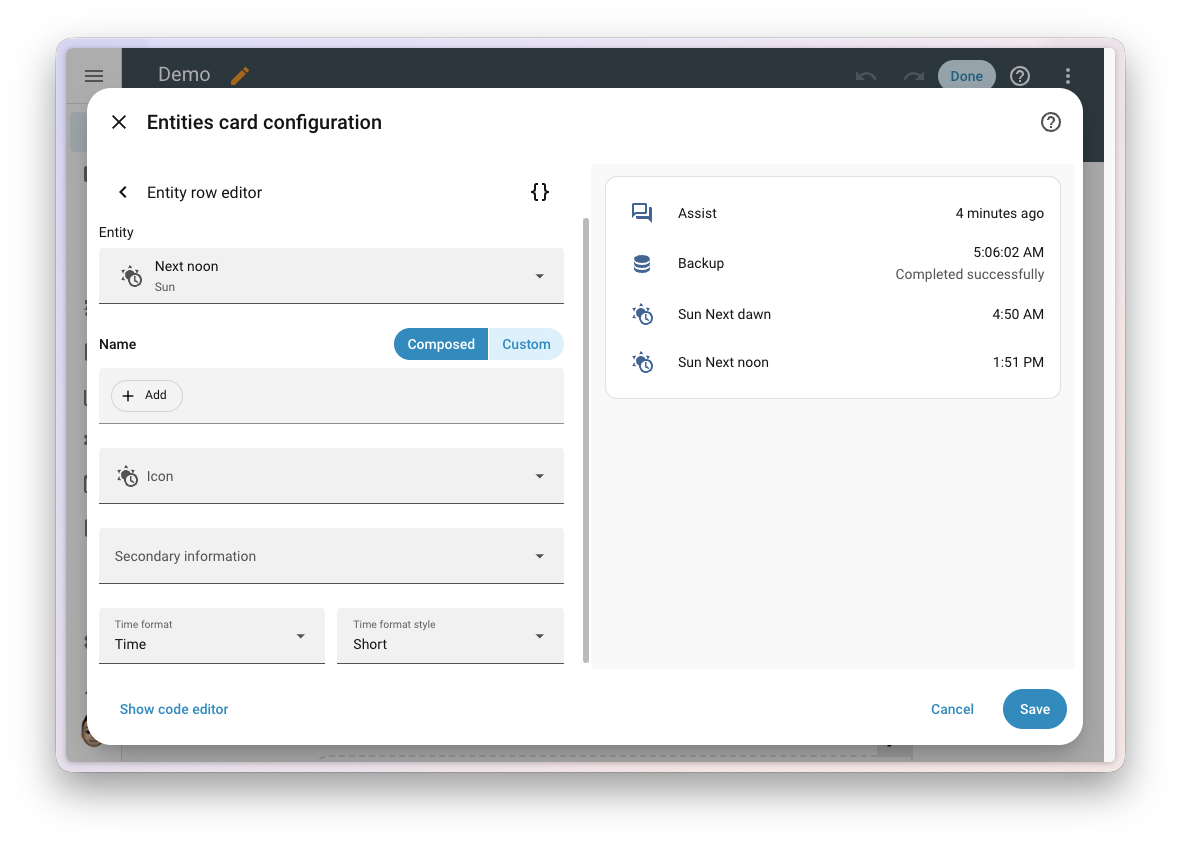
Until now, picking how a timestamp was displayed meant editing YAML. This release brings that choice into the UI. When you add a timestamp entity to a tile card, the entities card, or as an entity badge, a Time format option shows up in the editor, so you can choose how the time is presented, including a new short or long style for the relative format.
Thanks, @karwosts!
Devoted panels for infrared and radio frequency
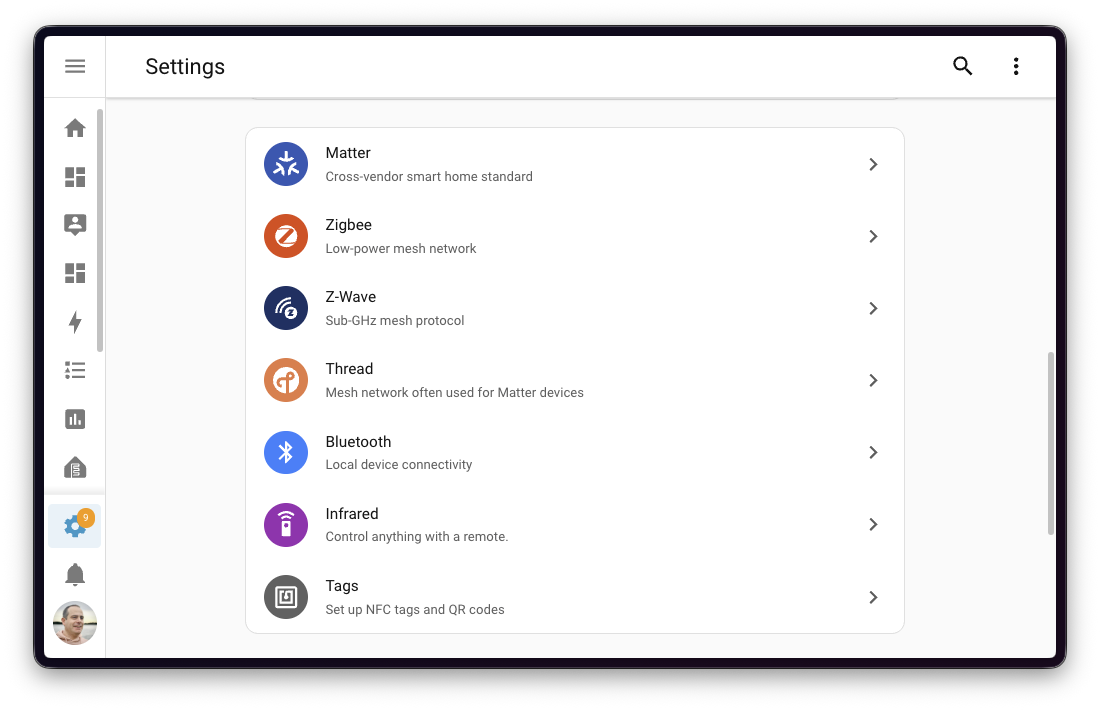
Earlier this yr, House Assistant gained devoted entity platforms for infrared and radio frequency devices, the building blocks behind integrations that reach your gear through an IR blaster or a 433 MHz transmitter. This release gives them a proper home.
Two new panels show up in the Settings menu, one for infrared and one for radio frequency. Each lists the proxies and transmitters you’ve set up, so you can see your IR blasters and RF bridges at a glance and jump straight to the one you’re looking for, instead of hunting for them among everything else. The panels only appear when you actually have such devices, so they stay out of the way if you don’t.
Thanks, @balloob!
The ZHA Zigbee system administration acquired an overhaul
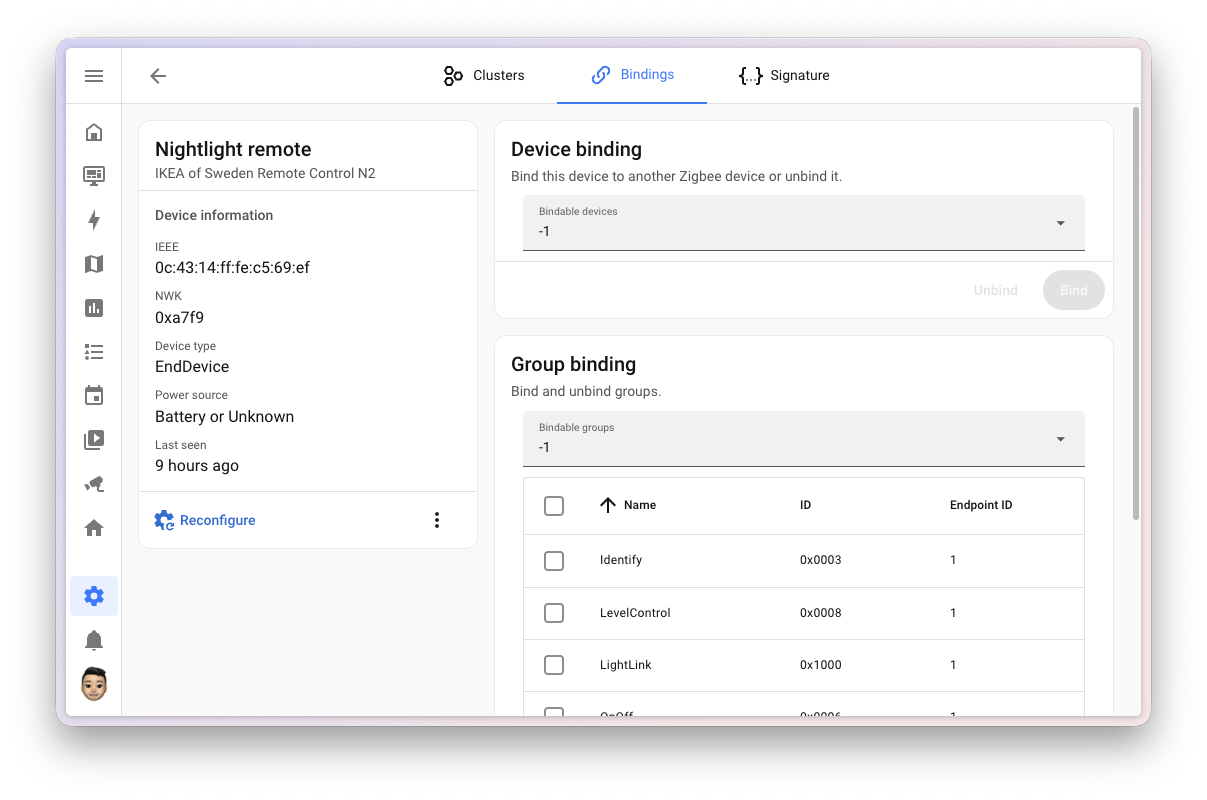
Managing a Zigbee system by means of ZHA used to mean squinting at a cramped dialog. The clusters, bindings, signature, and neighbors tools were all there, but crammed into a small popup that left little room to breathe.
This release moves all of that onto a dedicated, full-page device view. The same tools are now laid out across tabbed navigation, with a device summary card up top, and the loading, empty, and error states have been cleaned up throughout. It’s the same powerful Zigbee management, just far easier to work with.
Thanks, @jpbede!
Retaining your Raspberry Pi firmware updated
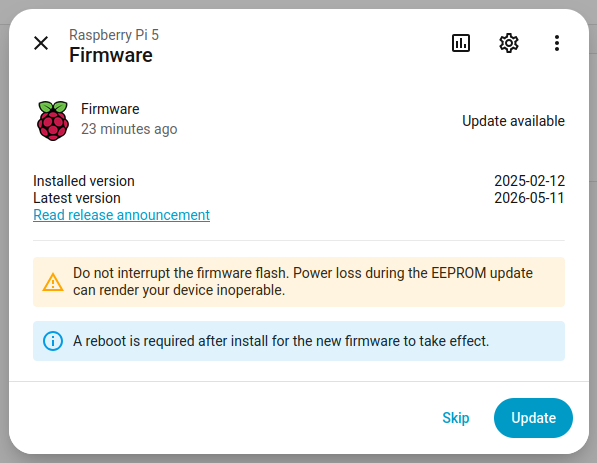
Running Home Assistant Operating System on a Raspberry Pi? You are in good company: per our public, opt-in analytics, the Raspberry Pi platform at the moment powers a couple of third of all installations. As of this launch, there’s an “replace entity”An replace entity is an entity that signifies if an replace is out there for a tool or service. [Learn more] for the Pi’s bootloader firmware, additionally sometimes called the EEPROM replace. You possibly can hold it present proper from Settings > Updates, the identical place you deal with each different replace.
That is greater than a nice-to-have. Particularly on the Raspberry Pi 5 and Compute Module 5, the firmware accommodates bug fixes, compatibility enhancements for NVMe drives, thermal enhancements, and far more. Till now, updating that firmware was cumbersome: you needed to flash one other SD card with a particular picture, or join a keyboard and a show and run the rpi-eeprom-update command by hand. Now it takes a single step.
A number of issues to bear in mind:
- This wants Home Assistant Operating System 18 or newer, which supplies the help the replace entity builds on. On older variations, the entity merely isn’t there.
- On a Raspberry Pi 4, the firmware can solely be up to date when the board boots from an SD card. In case your Pi 4 boots from USB storage, the replace isn’t obtainable. It is a limitation of the replace system, and another reason we advocate utilizing USB solely as an information disk whereas preserving an SD card as the primary boot system.
- Not each board can replace its firmware this fashion. Moreover a Raspberry Pi 4 booting from USB storage, the House Assistant Yellow with a Compute Module 4 isn’t supported both. The place an replace can’t be utilized, the entity doesn’t seem in any respect, so that you don’t see an replace that wouldn’t work.
- After the replace is utilized, House Assistant prompts you to reboot to finish it.
Thanks, @sairon!
Patch releases
We may also launch patch releases for House Assistant 2026.7 in July.
These patch releases solely include bug fixes. Our aim is to launch a patch
launch as soon as per week, aiming for Friday.
2026.7.1 – July 3
2026.7.2 – July 10
2026.7.3 – July 21
Apologies for shipping off schedule. This patch release should have shipped last Friday, but we weren’t able due to technical difficulties.
2026.7.4 – July 24
Need help? Join the community
Home Assistant has a great community of users who are all more than willing to help each other out. So, join us!
Our very active Discord chat server is an excellent place to be, and don’t forget to join our amazing forums.
Discovered a bug or situation? Please report it in our issue tracker to get it fastened! Or examine our assist web page for steerage on extra locations you may go.
Are you extra into electronic mail? Join the Open House Basis E-newsletter to get the most recent information about options, issues taking place in our neighborhood, and different initiatives that help the Open House straight into your inbox.
Backward-incompatible adjustments
We do our best to avoid making changes to existing functionality that might unexpectedly impact your Home Assistant installation. Unfortunately, sometimes it is inevitable.
We always make sure to document these changes to make the transition as easy as possible for you. This release has the following backward-incompatible changes:
Purpose-specific triggers and conditions
Several entity triggers and conditions, part of the new purpose-specific triggers and conditions, have been renamed so their keys are consistent across all domains. The old keys no longer work.
The following triggers changed:
-
battery.lowis nowbattery.became_low -
battery.not_lowis nowbattery.no_longer_low -
lawn_mower.dockedis nowlawn_mower.returned_to_dock -
schedule.turned_offis nowschedule.block_ended -
schedule.turned_onis nowschedule.block_started -
timer.time_remainingis nowtimer.remaining_time_reached -
update.update_became_availableis nowupdate.became_available -
vacuum.dockedis nowvacuum.returned_to_dock
The following conditions changed:
-
climate.target_humidityis nowclimate.is_target_humidity -
climate.target_temperatureis nowclimate.is_target_temperature
If an automation or script uses one of these, it will stop working until updated. To fix it, open the affected automation or script, re-select the trigger or condition (it now appears under its new name), and save. If you edit in YAML, replace the old key with the new one from the list above.
BSB-LAN
The BSB-LAN integration has diminished its help for the older model 1 JSON API. In case your BSB-LAN system runs very previous firmware that solely speaks the model 1 API, replace it to firmware that helps the model 2 API to maintain every thing working.
A restore notification will let you realize in case your system is affected.
Individual
Individual entities now not report the latitude and longitude of the house zone when their location comes from a presence scanner related to the house zone.
When you’ve got automations or scripts that examine the coordinates of an individual, alter them. To examine whether or not an individual is in a selected zone, use the brand new in_zones state attribute as a substitute.
(@emontnemery – #173042) (Individual documentation)
Rabbit Air
The Rabbit Air fan preset mode values modified from title case to lowercase to match House Assistant’s state conference: Auto is now auto, Guide is now handbook, and Pollen is now pollen. The user-facing labels keep the identical by means of translations.
Replace any automations, scripts, templates, or motion calls that reference the previous title-case preset values.
(@MagikalUnicorn – #172931) (Rabbit Air documentation)
Reolink
Reolink Duo PoE and Duo WiFi dual-lens cameras now expose a sub-device per lens. The digicam and movement/AI sensor entities that beforehand had a “lens 0” or “lens 1” suffix of their title are moved to the brand new lens sub-devices and lose that suffix. Entity IDs and customized names keep the identical, so most automations hold working.
If you happen to goal these entities by means of the digicam system, replace them to make use of the brand new lens sub-devices.
Tesla Fleet
The route system tracker (device_tracker.) now not stories the energetic route’s vacation spot title as its state. Its state is now derived out of your zones like a standard system tracker (house, not_home, or a zone title), based mostly on the route’s coordinates.
The vacation spot title continues to be obtainable by means of the brand new vacation spot sensor (sensor.), which is disabled by default. Allow it from the entity settings in case you have automations that relied on the vacation spot title, and replace any automations that matched the previous route tracker state.
Teslemetry
The route system tracker now not stories the energetic route’s vacation spot as its state or by means of a location_name attribute. Its state is now derived purely from the route’s coordinates (zone-aware, like house or not_home).
If you happen to relied on the vacation spot title, allow the brand new Vacation spot sensor (sensor.*_destination), which is disabled by default and stories the vacation spot title as Tesla supplies it.
Zeroconf
The legacy requires_api_password area has been faraway from the House Assistant zeroconf/mDNS discovery announcement (_home-assistant._tcp). It had been hardcoded to true because the http.api_password authentication mechanism was eliminated in House Assistant 2024.7, so it now not carried any which means. The official companion apps already ignore it.
Third-party discovery purchasers that also learn this area have to tolerate its absence.
(@agners – #173090) (Zeroconf documentation) (API documentation)
Zone
The state (individual depend) and individuals attribute of zone entities are actually calculated from the in_zones attribute of individual entities. Consequently, an individual can now be counted in a couple of zone on the similar time. For instance, an individual who’s house with in_zones: ["home", "near_home"] now counts towards each zone.house and zone.near_home, the place beforehand they solely counted towards zone.house.
As well as, the state of position-aware system trackers is now the smallest zone the system is in, as a substitute of the zone whose heart it’s closest to.
Automations, scripts, or templates that depend upon zone individual counts or on system tracker zone states could have to be adjusted.
(@emontnemery – #172942, #173106) (Zone documentation)
Z-Wave JS
This launch requires an up to date Z-Wave JS server. You want zwave-js-server 3.9.0 or newer (schema 49):
- If you happen to use the Z-Wave JS app, replace it to a minimum of model 1.4.0.
- If you happen to use the Z-Wave JS UI Docker container, replace it to a minimum of model 11.19.1.
- If you happen to run your individual zwave-js-server, replace it to a minimum of model 3.9.0.
(@AlCalzone – #173309) (Z-Wave JS documentation)
If you’re a customized integration developer and wish to study adjustments and new options obtainable in your integration: Make sure to comply with our developer blog. The next adjustments are probably the most notable for this launch:
All adjustments
After all, there’s much more on this launch. You’ll find an inventory of all adjustments made right here: Full changelog for House Assistant Core 2026.7.