


This mission report by Simmtronic first appeared in LED skilled Assessment (LpR) situation 115, Could/June 2026, as a part of the difficulty’s DALI Focus.
When Co-op Dwell opened in Manchester, it grew to become the UK’s largest indoor enviornment, with a capability of 23,500. It was designed from the outset to host a number of the most demanding reside leisure productions within the nation: main worldwide touring acts, sporting occasions, company capabilities and hospitality providers inside a single, extremely immersive atmosphere.
For the lighting management infrastructure, the dimensions of the venue was solely a part of the problem. The put in system includes practically 9000 luminaires, over 800 DALI-2 management traces and over 1500 enter units distributed throughout 33 IP Space Controllers. However the uncooked figures do not seize the operational complexity. A constructing of this kind doesn’t function as a single house. It operates as dozens of them. Public concourses, artist corridors, hospitality suites, manufacturing zones, places of work and back-of-house service areas every carry totally different operational necessities, totally different consumer expectations and totally different lighting behaviors. Some prioritize ambiance and dynamic coloration. Others rely solely on reliability and quiet automation. The management platform needed to serve all of them by a single, coherent system.
This text describes how a DALI-2 management infrastructure delivered by Simmtronic helps day-to-day operation of the venue. It focuses on 4 operational themes: the Simmtronic Dwell Standing Viewer because the true window into the system, supporting proactive upkeep and fast configuration; automated emergency testing by integration with the venue’s central battery infrastructure; BACnet integration that permits the venue’s AV manufacturing atmosphere to drive lighting throughout reside occasions; and the dynamic coloration management infrastructure that helps artist corridors and different immersive areas.
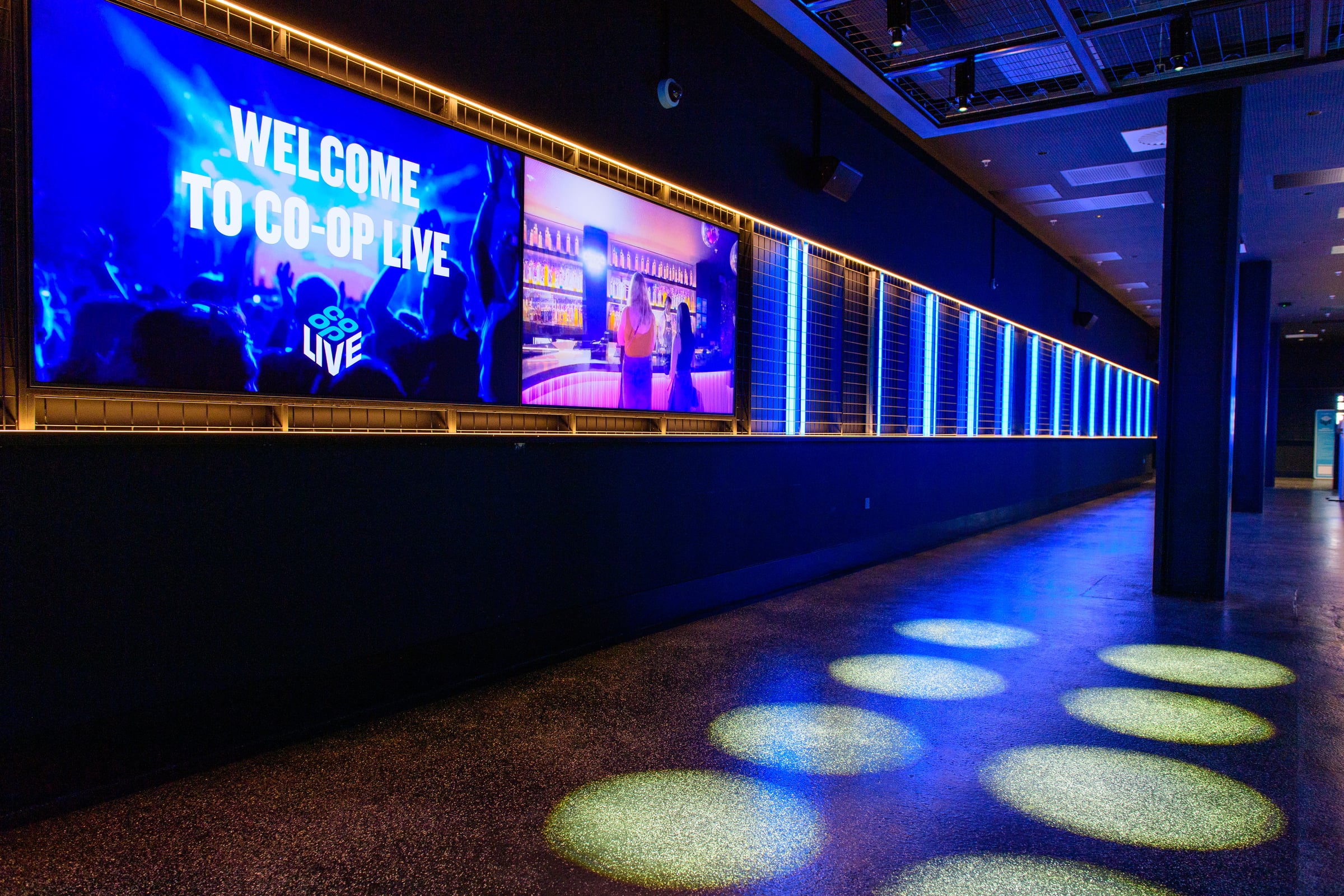
The Avenue, public concourse. (Picture: Simmtronic / Jon Parker Lee Images)
Why DALI for a venue of this complexity
DALI (Digital Addressable Lighting Interface) has, over the previous twenty years, turn out to be probably the most extensively adopted protocol for industrial and architectural lighting management. Its strengths are effectively documented: every luminaire and management system on a DALI bus carries a person tackle, and the protocol is supported throughout just about each main lighting producer.
The evolution of the usual into DALI-2 (IEC 62386) launched a number of refinements that matter to a mission of this complexity. Probably the most important is the unbiased certification program: units carrying the DALI-2 mark should go testing by an accredited physique, offering a significant assure of cross-manufacturer interoperability.
At Co-op Dwell, the put in Lighting Management Modules are Simmtronic’s DALI-2 compliant riser mounted Hardwired Hubs. Every has been independently examined and licensed in opposition to the rigorous DALI-2 commonplace, which provides the mission the reassurance of full protocol compliance and dependable interoperability throughout the broader DALI ecosystem related to it. The Simmtronic platform then helps these LCMs and the related DALI units all through their operational life.
The flexibility of the platform is one among its defining qualities. The identical Simmtronic infrastructure that helps Co-op Dwell additionally operates throughout industrial places of work like 22 Bishopsgate and The Scalpel, and throughout schooling environments just like the College of Northampton. The system will not be tied to a single constructing sort. It’s designed to be adaptable, scalable and suited to the operational actuality of no matter atmosphere it serves.
What issues most to a venue like Co-op Dwell will not be the protocol model in isolation. It’s what the protocol allows when mixed with clever head-end software program, well-designed enter units and a coherent commissioning method: each luminaire individually addressable, each group and scene reconfigurable in software program, suggestions is reported by the identical bus, and each change traceable by a single operational interface.
A single-master structure
Throughout Co-op Dwell, day-to-day management of the luminaires originates from 33 IP Space Controllers distributed all through the constructing. Every controller manages the lighting fed from its native distribution boards, speaking immediately with the related Lighting Management Modules, sensors and DALI infrastructure inside its space. The intelligence is distributed: real-time management doesn’t rely on a single central processor, and there’s no single level of failure. If anybody a part of the community is interrupted, the remainder of the system continues to operate autonomously.
The Simmtronic SPC.3020 head-end sits above this distributed management layer because the operational window into the system. It’s the place the BACnet integration with the manufacturing AV atmosphere is configured, the place the SPN.200 automated emergency testing is managed, and the place the Dwell Standing Viewer brings operational and upkeep visibility collectively in a single interface.
The structure has direct operational penalties. The services crew manages one system, one interface and one level of oversight. Exterior programs don’t management lighting independently; they impart with the Simmtronic platform by open protocols, together with BACnet, DALI and volt-free contact inputs, and the Simmtronic platform interprets and executes the suitable motion. The conduct of each luminaire throughout the venue, no matter space or operate, stays constant, auditable and manageable from a single platform.
The place a number of subsystems management lighting independently, even in well-engineered installations, the operational and upkeep burden rapidly multiplies. Conflicts come up between automation guidelines, error analysis crosses system boundaries, and configuration adjustments ripple unpredictably. The one-master mannequin avoids these points by making certain that each one management authority sits in a single place, whereas nonetheless permitting different programs to work together with lighting by well-defined integration interfaces. The lighting management infrastructure turns into a service that different programs use, quite than a peer they need to coordinate with.
Proactive upkeep by the Dwell Standing Viewer
In a venue working a substantial variety of occasions per 12 months throughout a number of areas and seating configurations, upkeep must be proactive. Complete, real-time monitoring is the hallmark of a professionally instrumented set up: its worth lies in giving the services crew steady confidence within the system and the power to behave early, in order that routine upkeep is anticipated and dealt with quietly, earlier than it’s ever seen to anybody within the venue. Something needing consideration is recognized by the system itself quite than ready on an occupant to report it and is positioned exactly and introduced to the upkeep crew in a type that helps fast decision.
That is the function of the Simmtronic Dwell Standing Viewer: an event-driven graphical interface that gives real-time visibility of each Simmtronic system and each DALI luminaire throughout the set up. The standing of each system is surfaced within the Viewer because it adjustments, quite than requiring the engineer to ballot the tools.
The Viewer’s central characteristic is computerized root trigger evaluation, which directs the engineer straight to the one merchandise that wants consideration quite than a protracted checklist to work by. The place a single underlying trigger produces a number of knock-on signs (as an example, a bus communication situation affecting downstream units) the system identifies the foundation trigger and units the secondary signs apart, so decision is quicker and extra sure. Every merchandise is accompanied by detailed steering and a really useful remedial motion.
For the services crew at Co-op Dwell, this interprets into a number of day-to-day capabilities:
- System standing is seen at a look. The Standing Viewer presents the reside standing of the entire venue, color-coded in opposition to the ground plans, with a key explaining each image. Something requiring consideration could be filtered by space or flooring.
- DALI bus topology is seen. The Viewer shows the bodily connections between units throughout the DALI buses, which helps upkeep groups find cable breaks, free connections and comparable bodily markers that may in any other case require important time to diagnose.
- Stock is complete. The Viewer extracts and shows full stock and configuration data from each DALI system on the system: producer, mannequin, serial quantity, firmware model and lamp run-hours, supporting each guarantee administration and proactive lamp alternative.
- Historical past is replayable. The Head-Finish logs each occasion for each system, together with presence detection, mild output ranges and photocell readings. The Viewer can recall and show full system standing for any historic level since set up. That is helpful for tracing causes of sudden conduct or analysing occupancy patterns over time.
For Upkeep Engineers, the Dwell Standing Viewer additionally capabilities as a configuration device. The place an operations crew member wants to regulate a scene degree, maybe to refine the look of a hospitality space or rebalance a concourse for a selected occasion configuration, they will accomplish that by a easy graphical interface, deciding on a number of luminaires and getting into the required mild degree. Dwell ranges could be arrange, adjusted and captured as scenes for future recall.
Entry to those instruments is managed by the SPECS Authentication, Authorisation and Accounting System. Engineers with applicable coaching have entry to the broader SPECS Supervisor atmosphere, the place advanced configuration adjustments could be made. Day-to-day upkeep workers use an easier subset of instruments that helps the commonest changes (preset scene ranges, presence timeouts and comparable settings) with out exposing extra delicate configuration parameters.
The mixture of system well being monitoring, stock administration, historical past replay and straightforward adjustment in a single graphical interface means the venue’s services crew can carry out the vast majority of operational duties themselves, with out exterior assist. It’s what makes the infrastructure operationally self-sufficient over the venue’s lengthy lifecycle.
Automated emergency testing by the SPN.200 system
Emergency lighting in a big public venue presents a troublesome steadiness. Statutory testing underneath BS 5266 requires that each emergency luminaire be examined for each operate and period. In a venue like Co-op Dwell, the place the constructing could also be in use for occasions on any given day, these checks can not disrupt occupants. Extra importantly, they need to by no means compromise the security of any space.
At Co-op Dwell, the emergency lighting is delivered by 4 Central Battery Models (CBUs) powering DALI-ballasted emergency luminaires. The Simmtronic SPN.200 Computerized Testing System integrates immediately with the CBUs to handle testing, monitor system well being and document the statutory testing regime.
The structure is basically fail-safe. In regular operation, every emergency luminaire is powered from the CBU and managed by DALI instructions from the lighting system. Within the occasion of an influence outage, the DALI line loses energy and the DALI-compliant ballast routinely lights at its pre-configured emergency degree, utilizing mechanisms constructed into the DALI commonplace particularly for this function. No communication to the luminaire is required for emergency operation. This makes the emergency response inherently dependable: if something within the lighting management chain is interrupted, whether or not an LCM, a DALI bus or the head-end itself, the emergency lighting nonetheless prompts.
As a result of the DALI buses are powered from the native lighting circuit, there is no such thing as a requirement for change-over relays at every emergency luminaire. The luminaires are fed from the CBU and the DALI ballast handles the transition to emergency operation autonomously. This single design determination delivered important on-site financial savings in each tools value and set up labor. It additionally simplifies long-term upkeep: there are not any particular person change-over relays at every luminaire to fail or substitute.
The SPN.200 system manages testing in three layers:
- Steady monitoring. The ATS interrogates each DALI ballast regularly. Ballast, wiring or lamp suggestions is reported as quickly as they’re detected, quite than ready for the subsequent scheduled take a look at. The CBU’s personal standing indicators (system in operation, provide from battery, and battery cost state the place out there) are surfaced by the Dwell Standing Viewer.
- Month-to-month operate checks. The ATS instructions the CBU to simulate a provide failure for a brief interval, enough to confirm that each emergency luminaire lights appropriately from battery energy. Every ballast is individually interrogated to substantiate it’s responding and appropriately lit. Perform checks run routinely out of hours, with no walk-test requirement.
- Annual period checks. A full three-hour discharge take a look at on every CBU verifies that the battery can maintain the rated load for its declared period. The ATS will solely provoke a period take a look at as soon as it has confirmed that the CBU is totally recharged and that an sufficient proportion of luminaires are responding appropriately.
The testing sequence is rigorously ordered to guard constructing security all through. Earlier than commanding a CBU to modify to battery provide, the ATS first verifies that each DALI ballast within the related emergency luminaires is responding and appropriately configured. If an insufficient proportion of luminaires are operational, the take a look at is aborted earlier than any battery discharge takes place, stopping pointless depletion of the batteries. Solely when the system is assured the take a look at will likely be legitimate does it command the CBU to modify to battery operation, confirm every luminaire continues to mild from the battery, and return every thing to regular provide as soon as the take a look at is full.
The sensible penalties for Co-op Dwell are substantial:
- Protection is 100%. Each emergency luminaire is examined, not only a sampled subset, and each take a look at result’s centrally logged.
- File conserving is computerized. Check historical past for each luminaire and each CBU is recorded and out there for inspection at any time. Check report summaries could be generated and printed on demand.
- Diagnostics are clever. The system distinguishes between ballast failures, lamp failures, battery and inverter queries, and presents a transparent remedial motion for every.
- Places are proven graphically. Any merchandise requiring consideration is displayed with upkeep directions that may be printed.
- Pre-emptive detection. Many defects are caught between formal checks by steady ballast monitoring, quite than solely being found on the subsequent scheduled take a look at.
The SPN.200 method is extremely built-in throughout the wider SPECS platform. Emergency lighting standing seems in the identical Dwell Standing Viewer used for common suggestions administration, so a problem on an emergency luminaire is introduced to the operator by the identical interface as every other fault within the constructing.
For a venue with the public-facing security profile of Co-op Dwell, the operational reassurance this supplies is critical. The system delivers full, automated, statutorily compliant testing with out ever placing an space of the constructing in danger throughout a take a look at cycle.
BACnet integration with the manufacturing AV atmosphere
Fashionable leisure venues function with deep integration between their AV, lighting, constructing administration and manufacturing programs. At Co-op Dwell, this integration was notably vital throughout reside occasions, the place the manufacturing crew required the power to handle lighting scenes and coloration environments immediately from the manufacturing AV atmosphere, with out requiring an operator to be current at a Lighting Management interface throughout a present.
The Occasion Bowl with Simmtronic Dwell Viewer. (Picture: Simmtronic / Jon Parker Lee Images)
The combination is delivered by Simmtronic’s BACnet interface, configured from the SPC.3020 head-end and forming a part of the SPN.400 Knowledge Change Suite. The BACnet interface exposes lighting system knowledge and management factors to different constructing and IT programs by a well-defined open commonplace, permitting exterior platforms to ship management instructions and to retrieve standing data from the lighting infrastructure.
Architecturally, the mixing follows the single-master precept. The manufacturing AV atmosphere doesn’t assume direct management of the lighting infrastructure. As an alternative, the AV system sends BACnet directions to the Simmtronic head-end: change to this scene, set this group to this coloration, recall this preset. The Simmtronic platform interprets these directions and executes the suitable motion on the lighting infrastructure. To the manufacturing engineer, the expertise is seamless: scene adjustments occur on cue from the AV atmosphere. However the lighting infrastructure stays underneath unified Simmtronic management all through, with all exercise logged by the Viewer and visual to the services crew.
This method has a number of benefits over a extra direct or distributed management mannequin:
- All lighting exercise is logged centrally. Each scene change triggered by the manufacturing atmosphere is recorded by the Simmtronic head-end and seems within the historic occasion log.
- The lighting infrastructure can’t be inadvertently misconfigured. The AV atmosphere can solely set off predefined behaviors (scenes, presets, ranges) which have been configured throughout the Simmtronic system. Decrease-level configuration parameters stay protected behind the lighting administration interface.
- Integration is strong to alter. As manufacturing workflows evolve, new BACnet objects could be added to the mixing with out adjustments to the AV system structure.
- Responsiveness is configurable. The place low latency is vital, the BACnet Initiator mechanism pushes occasions to the exterior system as they happen, quite than counting on the exterior system to ballot. That is notably helpful for presence indications and different event-driven knowledge.
At Co-op Dwell, the BACnet integration is the route by which the manufacturing AV atmosphere communicates with the lighting infrastructure throughout reside occasions. The identical interface supplies an outlined path for different constructing programs to work together with the lighting platform, whether or not to ship management instructions or to retrieve standing knowledge corresponding to presence indications, or luminaire well being to be used elsewhere within the wider constructing know-how stack. The lighting infrastructure turns into a knowledge supply for the broader constructing intelligence layer, offering a number of the most operationally helpful real-time knowledge out there in any trendy industrial venue: presence at each detector, mild degree at each photocell, and luminaire standing throughout the property.
Management Room with Simmtronic Tools. (Picture: Simmtronic / Jon Parker Lee Images)
Dynamic coloration management by DMX and the Dwell Standing Viewer
A significant proportion of the lighting at Co-op Dwell is color-changing: artist corridors with immersive RGB environments, accent areas that shift coloration in line with occasion branding, and dynamic surfaces that reply to manufacturing cues. The management infrastructure for these areas is constructed round DALI-driven DMX conversion, with Simmtronic SPO DALI-to-DMX interfaces plugged immediately into Simmtronic’s DALI2 Lighting Management Modules and feeding the color-changing fittings downstream.
The SPO interface is designed particularly for this use. It attracts its energy from the LCM and converts the DALI sign from the LCM right into a DMX output. The interface helps a 50-color pre-programmed RGB palette selectable immediately from SPECS3 scenes, in addition to DALI short-address to DMX-channel mapping for finer management the place required.
This method provides the venue the advantages of DMX’s high-speed, high-resolution coloration management the place it’s required, whereas conserving color-changing lighting totally built-in throughout the Simmtronic DALI infrastructure. The DMX interfaces then sits downstream of the Simmtronic platform. They don’t seem to be unbiased management programs, however extensions of the principle platform’s attain into color-changing territory. Scenes, presets and dynamic results throughout these areas are configured, saved and recalled in the identical approach as standard dimming scenes elsewhere within the venue. For the operations crew, the sensible interface for coloration management is identical Dwell Standing Viewer used for system administration and scene adjustment. The configuration device for multi-colored luminaires supplies two complementary strategies for setting coloration:
- The Coloration Wheel. Operators choose a number of luminaires, then select a base coloration from a graphical coloration wheel and alter brightness with a slider. That is the pure technique for establishing the look of an area rapidly. Operators transfer by coloration house visually quite than working with numerical values.
- RGBW values. The place precision issues, maybe matching a model coloration or replicating a lighting state from a earlier occasion, operators can enter precise RGB or RGBW values, with full numerical management over every channel.
The configuration device additionally supplies copy-and-paste capabilities throughout a number of luminaires, which is important when establishing advanced lighting patterns throughout lengthy corridors or giant dynamic surfaces. A configuration utilized to at least one luminaire could be copied to a bunch of others on the click on of a button, making certain constant conduct with out the danger of handbook entry errors.
For Co-op Dwell, the result is a coloration management atmosphere that helps fast modification throughout occasion set-up, releasing the crew to give attention to the extra time-consuming areas of venue preparation, alongside the precision required for thought of scene design. The identical Engineer engaged on proactive upkeep within the venue’s back-of-house areas can, by the identical interface, step into the artist corridors, alter the colour of an immersive lighting set up, seize the consequence as a scene, and recollect it for future occasions.
What Co-op Dwell demonstrates for DALI-2
Co-op Dwell is a venue of appreciable operational complexity: a number of utilization modes, numerous areas, demanding manufacturing workflows and a major public security profile. Delivering a lighting management infrastructure that helps all of this by a single coherent platform required greater than a sturdy {hardware} set up. It required a head-end software program atmosphere able to turning the info flowing by the DALI buses into usable operational intelligence, and integration instruments that might join the lighting infrastructure cleanly to the broader constructing and manufacturing know-how stack.
The Simmtronic platform on the venue supplies this by a tightly built-in mixture of capabilities: DALI-2 compliant LCMs because the addressable basis; the SPN.200 computerized testing system for compliant emergency monitoring that by no means places any space in danger; the SPC.3020 head-end and SPN.400 knowledge trade suite for clear BACnet integration with the AV manufacturing atmosphere; the SPO DALI-to-DMX interface for dynamic coloration management the place it’s wanted; and the Dwell Standing Viewer because the operational and upkeep window throughout all of it.
For specifiers and operators contemplating DALI-2 for a fancy venue, the lesson is that the worth of the protocol is realised in what the head-end software program does with the info it carries. DALI-2 supplies the inspiration. What the on-site engineer experiences everyday, together with proactive upkeep, automated testing, built-in management and intuitive coloration administration, relies on the software program atmosphere constructed round it.
That distinction issues more and more as industrial and leisure buildings turn out to be extra data-driven, extra built-in with adjoining programs, and extra accountable for his or her operational efficiency. Lighting management infrastructure is now not an remoted electrical service. It is among the most dear real-time knowledge sources in any trendy constructing, and at Co-op Dwell it’s delivering on that potential. For the venue itself, the sensible final result is a lighting platform it could belief and run with confidence: predictable in each day operation, self-sufficient for its services crew, and engineered in order that the uncommon occasion needing consideration is dealt with quietly and early, effectively earlier than it may ever attain an viewers.
Supply: Simmtronic, “23,500 Seats, One Clever DALI-2 Platform – How DALI-2 Grew to become the Basis for Proactive Lighting Management Throughout Co-op Dwell, the UK’s Largest Indoor Enviornment”, LED skilled Assessment (LpR) 115, Could/June 2026, DALI Focus. Extra data: www.simmtronic.com. Photographs: Simmtronic / Jon Parker Lee Images.