


Z-Wave Regulatory Course of
introduction
Z-Wave IoT units are purposeful radiator License-free use of radio waves within the Worldwide Telecommunication Union (ITU) Trade, science, drugs (ISM) a lot of the world’s spectrum besides Europe. The 868MHz band is utilized in an identical means in Europe, however is regulated. ETSI and Sept Nonetheless, it’s usually incorrectly known as a part of the ISM band. Because the guidelines are virtually the identical, there isn’t a drawback in calling all of them “ISM bands”.
The important thing necessities for all intentional radiators are: might not trigger dangerous interference, and should settle for any incoming interference. The precise guidelines that should be adopted are complicated and detailed in every customary. This put up supplies a abstract of the necessary elements, however outcomes might fluctuate, so we defer to skilled testing companies.
Z-Wave Lengthy Vary (ZWLR) has the benefit of unfold spectrum, and laws within the US permit as much as +30dBm of radiated energy. Z-Wave chips solely have a most energy of +20dBm, so there’s often loads of headroom. Check homes ought to nonetheless be checked, however ZWLR is often not a difficulty for regulatory testing. The primary concern is the Z-Wave mesh, which makes use of FSK modulation at 0dBm within the US and +14dBm within the EU. Narrowband FSK indicators can exceed regulatory necessities in sure instructions or in sure modes of operation. Working with regulatory consultants can prevent cash in the long term and preserve your product launch dates on observe.
finest practices
Check homes sometimes use specialised gear to carry out the required RF assessments. The objective is for testing to be accomplished inside in the future. The price is excessive, at greater than $10,000, and any delays incur further expenses. Every take a look at home and every take a look at engineer performs assessments in another way. Some are stricter, others extra permissive. Be ready to handle any firmware points up to date on-site. Testing can considerably overrun your schedule, so plan your RF assessments far sufficient upfront to permit the PCB to be re-rotated if needed, particularly when utilizing PCB antennas.
- Ship a number of items of every kind
- In case the unit fails or fails an RF take a look at.
- Clearly label every unit’s performance
- Embody detailed setup directions with images
- Methods to wire the ability provide or battery
- Methods to join UART
- Embody detailed step-by-step directions
- Methods to modify TX energy degree for Z-Wave mesh
- If allowed, we’ll ship an engineer together with instruments to rebuild and modify the firmware.
- Pre-test as a lot as potential and collaborate with regulatory consultants
US FCC
Part 15.249, Basic Low Energy Intentional Radiators, is the first necessities doc. Part 15.5 describes the final requirement {that a} machine function on a non-interference foundation and should settle for any interference obtained. Sections 15.209 and 15.205 specify limits for emissions under the elemental wave. Part 15.207 requires that no radio waves be transmitted over AC energy strains. Part 15.201 units forth the necessities for receiving formal proceedings. FCC device Authorization.
Part 15.249 specifies that radiation outdoors the 902-928 should be attenuated by not less than 50dB of the elemental (this rule is extra complicated, however that is the worst case). That is usually a problem with Z-Wave meshes.n.d.,3rd,4th or 5th Harmonics could cause spurious emissions that exceed this requirement. These emissions may be attributable to a foul floor airplane, the PCB structure of matching passive parts, the antenna itself, or many different points.
The primary configuration settings for regulatory functions are to measure the values of APP_MAX_TX_POWER_LR, APP_MAX_TX_POWER, and APP_MEASURED_0DBM_TX_POWER (Resolution dBm), that are entered within the file config_rf.c. These are the three parameters that configure the utmost radio transmit energy. APP_MAX_TX_POWER_LR is just set to the utmost energy that the chip can assist, +14dBm (+140 in deci-dBm) or +20dBm. APP_MEASURED_0DBM_TX_POWER is often set to zero until the antenna has important achieve. APP_MAX_TX_POWER is then set primarily based on measurements in any respect frequencies, azimuths, and contemplating spurious emissions and different guidelines. Ideally this could even be set to zero, however usually must be set barely decrease to fulfill regulatory guidelines. Whether it is set under -4.0dBm, it’s best to perceive the issue intimately and think about redesigning the antenna, PCB, and filtering circuitry. Decrease settings might not meet the minimal RF vary of the Z-Wave mesh and will lead to poor RF vary efficiency.
What I do not like about this stream is that the transmit energy is measured within the take a look at home utilizing a very totally different firmware (RAILTest or Radio CLI) relatively than the appliance firmware. Ideally, there could be a mode within the software firmware to place the radio into service mode in order that the appliance and SDK can set the utmost transmit energy appropriately. This has been requested for years, however to this point it hasn’t made it to the precedence listing. The primary purpose for not enabling this characteristic is that it is extremely straightforward for a firmware bug to activate the transmitter and trigger a Z-Wave jammer. Within the early days of Z-Wave, there have been some units that had been jammers. In consequence, this performance has been faraway from the appliance SDK. Finding jammers is a troublesome job for skilled RF engineers and just about unimaginable for the common sensible residence client.
spurious radiation
There are numerous elements to regulatory testing, however the commonest drawback I’ve seen is momentary spurious emissions.
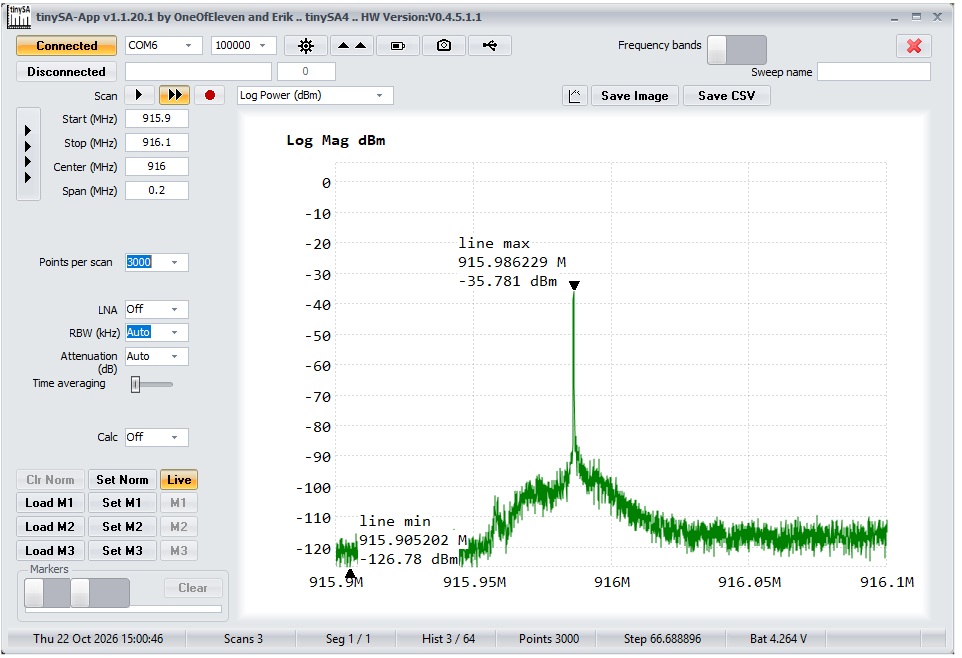
An integer a number of of the elemental (2, 3, 4, 5). FCC guidelines require spurious emissions to be 50dB under the elemental (there are extra particulars to this rule than I can cowl right here, however that is the worst case). Within the instance proven right here, the elemental is 916MHz and the measured energy is -36dBm. The cheap spectrum analyzer I take advantage of is not calibrated to the extent of accuracy I want, however it’s tremendous for a fast verify. Check homes use very costly and calibrated gear.
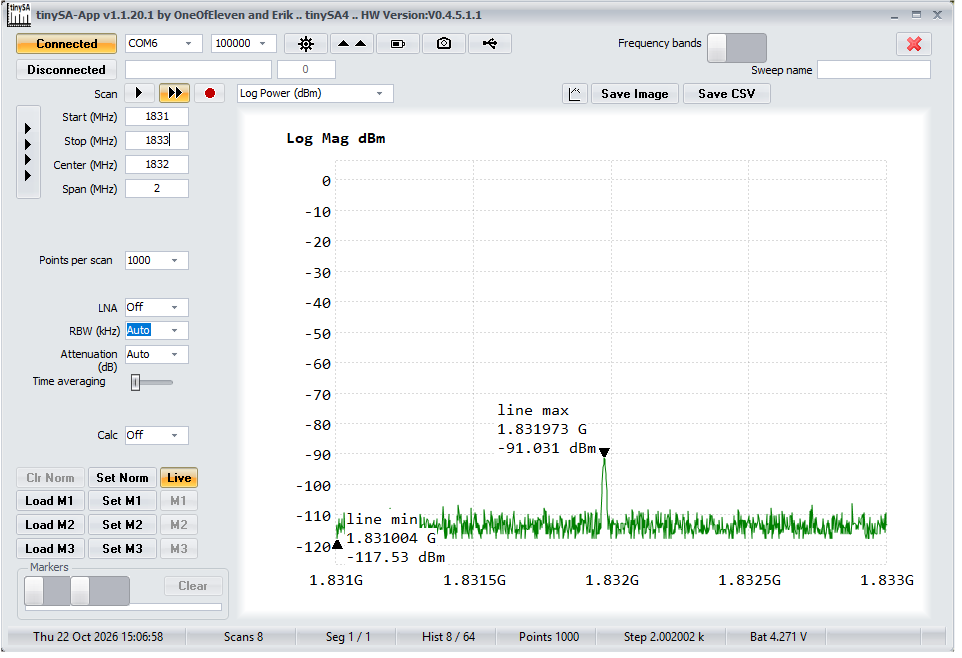
The second harmonic is at 1.8 GHz and has an influence of -91 DbM, which is 55 dBm under the elemental, so it meets the FCC necessities with a 5 dBm margin, which isn’t a lot.
Spurious emissions is usually a drawback at integer multiples of the crystal frequency. The problem right here is that the published FM band (89-108MHz) has extreme limitations. Silicon Labs makes use of a 39MHz crystal with an FM band between the 2nd and third harmonics. The Trident makes use of a 32MHz crystal with a 3rd harmonic at 96.0 MHz on the FM dial, so the PCB structure of the crystal is necessary.
Silicon Labs RAILTest
RAILT test Silicon Labs’ Radio Abstraction Interface Layer (RAIL) take a look at software that runs on Z-Wave chips. This software makes use of the command line to enter instructions into the radio and output the specified take a look at indicators. RAILTest is a posh software with lots of of instructions, just a few listed under are required for Z-Wave testing. Fortuitously, all of the instructions you might want to take a look at Z-Wave are inbuilt, so that you need not customise your radio configuration. RAILTest should be constructed utilizing Simplicity Studio for particular Z-Wave chips. It’s then flashed onto the board and the UART terminal is linked to the machine. see this KBA Steps to map measured most TX energy ranges to values compiled into code.
RAILTest within the 2026.6.2 SDK launch requires two further software program parts: CLI:Storage for NVM3, which depends on the default configuration of NVM3. These are wanted to mechanically energy up the machine and retailer in flash the scripts wanted to run the script and output the service wave. Seek for NVM3 within the mission’s software program parts and “Set up” the CLI:Storage in NVM3 part named “inst0”. Subsequent, construct the mission and flash it to your machine.
RAILTest Z-Wave command listing
| directions | clarification |
| set rx 0 | To allow different settings, put the radio in IDLE mode |
| Units Wave Mode 1 3 | Allow Z-Wave mode |
| Arrange the channel [0-3] | Frequency varies by area
0=100kpbs FSK (912MHz)Z-Wave mesh mode 1=40kbps FSK (908MHz) 2=9.6kbps FSK (908.42MHz) 3=100kbps DSSS-OQPSK (916MHz or 912) ZWLR |
| set energy [-127-+127] [raw] | Transmission energy (decidBm) (0.1dBm)
RAW makes use of “uncooked” register values [0-200] This command echoes each RAW and decdBm values. |
| settxstream [0-1] | Modulated service transmission on/off
PN9 random stream |
| set tone [0-1] | Turning unmodulated service transmission on/off |
| enter script [1-5] | Begin capturing scripts – as much as 5 scripts
Finish with “finish script” |
| clear script [1-5] | Erase the chosen script |
| print script [1-5] | Record scripts |
| execution script [1-5] | run the script |
pattern script
This script runs on energy up and outputs a 916MHz unmodulated service. Check homes sometimes require a tool that merely powers up and outputs an unmodulated service wave on the desired frequency. You could possibly additionally cut back the variety of units sending directions on the best way to change frequency and modulation, however after all it could take longer to check.
| clear script 1 | take away earlier script |
| Please enter script 1 | Begin capturing script #1 |
| Obtained 0
Units Wave Mode 1 3 Units Wave Area 11 set energy 200 set channel 0 set tone 1 trailing script |
Paste this to create your script |
| print script 1 | Please ensure that it’s entered accurately |
| reset | Reset the chip – the script ought to auto-run and ship |
Trident Radio CLI
Trident IoT has an identical command line software that’s constructed and flashed utilizing the elcap software. of Wireless CLI is a pattern software with the performance required for regulatory testing. The Tridents software is an easy software with good documentation and command completion (press TAB), which is helpful for individuals with huge fingers. This software is simple to construct, obtain to your board, and hook up with your UART through Segger J-Hyperlink. Be aware that within the 2026.06 SDK, the default baudrate for the UART is 230400, which is twice the traditional 115200 utilizing the command “elcap machine tty –baudrate 230400 –usb”.
Wi-fi CLI Z-Wave Command Record
You could find the whole command listing. here. Under is an inventory of instructions required for regulatory testing.
| directions | clarification |
| zw_init | Initialize the radio |
| zw-region set [0-103] | 0=EU, 1=US Mesh, 2=ANZ, 3=Hong Kong, 9=USLR, |
| zw-tx-channel set [0-3] | Frequency varies by area
In area 9 USLR 0=916, 1,2=908.42, 3=912 |
| zw-tx-power-set [-20-+20] | Transmission energy (dBm) |
| zw-radio-tx-continus_set [on,off] [0-2] | Service transmission on/off
0=no modulation, 1=modulation mounted sample, 2=modulation white |
| rx [on,off] | Flip reception on/off |
| Beginning the script [1-5] | Begin capturing scripts – as much as 5 scripts
Ends with “.performed” |
| script [autoon,autooff] [1-5] | Allow/disable automated execution of scripts on power-on. |
| Loading the script [1-5] | Enter a number of strains of script without delay |
| run [1-5] | run script quantity |
| grasp on # | #wait milliseconds |
| state of affairs | Shows the present standing of the radio |
pattern script
This script begins on power-up and outputs a 916MHz unmodulated service.
| script load 1 | Permits the script to be loaded on the subsequent line |
| zw-init
zw-region-set 9 zw-tx-channel-set 0 zw-radio-tx-continus_set on 0 . finish |
Paste this to create your script |
| script orton 1 | Allow automated script execution on power-on |
| reset | Reset the chip – the script ought to auto-run and ship |
subsequent step
The ultimate half 10 of the Z-Wave Developer’s Journey covers mass manufacturing and the best way to program, take a look at, and print the QR codes required for all licensed Z-Wave units. As we proceed our Z-Wave developer journey, we welcome your feedback and questions. Please be happy to contact me straight through electronic mail.
Concerning the writer
Eric Ryherd has been on the forefront of Z-Wave innovation since 2003, first as a advisor after which as a subject functions engineer at Silicon Labs. All through his profession, he has contributed to the design and improvement of a variety of Z-Wave merchandise, together with sensors, distant controls, motorized blinds, and in-wall dimmers. Many of those are available on the market at the moment.
Though Eric “retired” in 2022, he stays deeply concerned in embedded methods and Z-Wave improvement via his weblog DrZWave.weblog and ongoing IoT consulting tasks. He’s additionally a well-known face at Z-Wave Alliance Unplug Fests, steadily serving as lead coordinator and supporting interoperability and developer collaboration.