


Greater than 41,000 years in the past, a number of the first people to set foot in Tasmania used hearth to rework jungle right into a panorama appropriate for survival, in line with new analysis. The invention is the earliest proof of panorama administration by hearth in Tasmania, highlighting the ingenuity and connection to the land of those historic communities.
journal: Science Advances, November 15, 2024, DOI: 10.1126/sciadv.adp6579 |Studying time: 6 minutes
Revealing historic land managers
Researchers led by Dr Matthew Adeleye from the College of Cambridge, in collaboration with the Australian Nationwide College (ANU), analyzed charcoal and pollen in historic mud from Tasmania’s Bass Strait Islands. Their findings revealed that the indigenous Tasmanian individuals often known as the Palawa or Pakana individuals used managed burns to clear dense, moist forests. This follow started about 41,600 years in the past, about 2,000 years sooner than earlier estimates.
“These early Tasmanian communities have been the island’s first land managers,” says Adelai, who accomplished his PhD at ANU. The evaluation confirmed that as forests transitioned into open landscapes appropriate for human actions, charcoal deposition elevated quickly, coinciding with vegetation modifications. Such modifications recommend that fireside was used deliberately to change the setting.
This era of transformation occurred over the last Ice Age, when Tasmania was linked to mainland Australia by a land bridge. Migration throughout this huge space often known as Sahul made it potential to settle in Lutlwita (Tasmania). These communities used hearth as a instrument to adapt to the glacial setting and set up a sustainable lifestyle.
Science of fireplace and adaptation
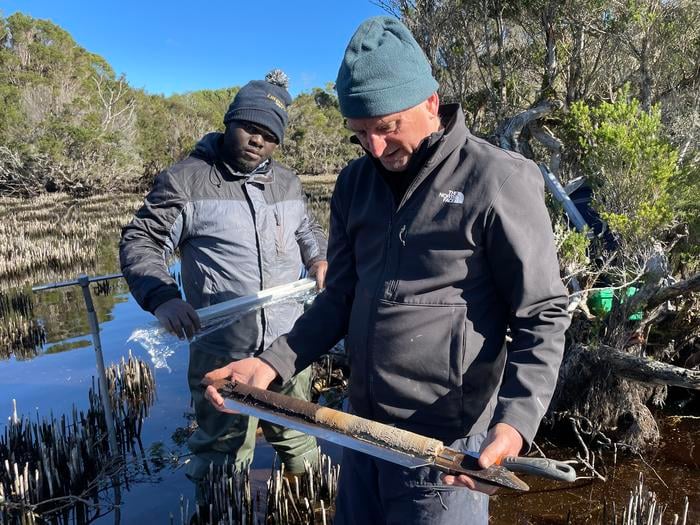
To uncover this deep historical past, researchers extracted historic mud core samples. Charcoal fragments indicated fires, and pollen grains indicated modifications in vegetation. These early inhabitants used hearth strategically, Adelai mentioned. “As pure habitats adapt to cultural burning, we’re seeing an enlargement of fire-adapted species resembling eucalyptus, totally on the moist aspect of the Bass Strait Islands.”
These findings affirm that the Palawa individuals used a fire-shaped ecosystem to develop species that thrived in burnt environments. Such practices are in step with the widespread use of fireplace by Aboriginal individuals throughout Sahul, the place hearth facilitates not solely survival but additionally the expression of tradition. The affect of those discoveries extends past the previous. Understanding this historic connection between individuals and land can inform fashionable approaches to ecosystem restoration and bushfire administration in Australia.
Bridging the previous and future
Researchers emphasize the significance of integrating indigenous information into fashionable panorama administration. ANU Professor Simon Havel mentioned: “To guard Tasmania and Australia’s landscapes for future generations, we have to pay attention and be taught from Indigenous communities who need a better position in managing Australia’s landscapes into the long run. is necessary.”
Cultural burning is a follow nonetheless maintained by many Aboriginal communities and has the potential to handle Australia’s bushfire challenges. Nonetheless, its widespread adoption stays controversial. This examine highlights the necessity for partnerships that respect and incorporate indigenous experience, particularly as local weather change will increase hearth dangers globally.
Glossary
- Palawa/Pakana: An indigenous Tasmanian tribe often known as Lutlewita.
- Cultural combustion: Managed hearth practices utilized by indigenous communities to sustainably handle landscapes.
- Sahul: A prehistoric continent that included Australia, Tasmania, New Guinea, and close by islands.
- Charcoal evaluation: A way of learning previous hearth occasions by inspecting microscopic charcoal fragments in sediments.
- eucalyptus: A genus of fire-adapted timber native to Australia.
interactive quiz
1. What strategies have researchers used to check the traditional use of fireplace?
They analyzed charcoal and pollen within the sediment cores.
2. When did the primary proof of the usage of hearth happen in Tasmania?
Roughly 41,600 years in the past.
3. What’s cultural combustion?
The follow of managing and utilizing hearth for ecological and cultural functions.
4. Why is that this analysis necessary for contemporary Australia?
Highlights the position of indigenous information in sustainable panorama administration.
Get pleasure from this story? Subscribe to our e-newsletter scienceblog.substack.com