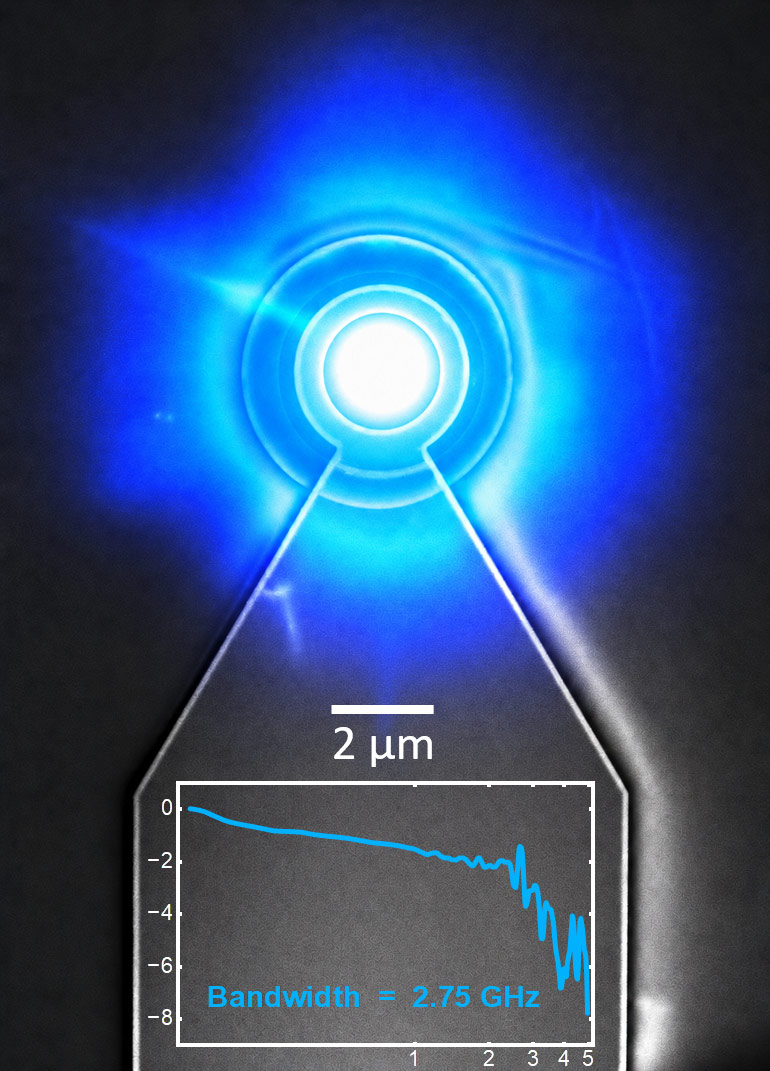



The College of Illinois at Urbana-Champaign (UIUC) has achieved a document modulation bandwidth of two.75 GHz in gallium nitride (GaN) blue micro-LEDs (Abdelghany Abouelnagga et al, IEEE Electron Machine Letters (October 21, 2026); doi: 10.1109/LED.2026.3745737).
This research gives a scientific scaling roadmap for microemitters and exhibits how they will change conventional electrical copper hyperlinks to remove power and bandwidth bottlenecks in knowledge facilities and next-generation AI computing.
Because the demand for synthetic intelligence and high-performance computing skyrockets, present copper-based knowledge interconnects are failing as a result of they eat giant quantities of energy, generate giant quantities of warmth, and can’t maintain the required knowledge charges, the group notes. Optical interconnects supply an answer, however vital challenges stay in creating compact, high-performance mild sources. Micro-LED arrays are promising candidates for creating massively parallel and error-free optical knowledge hyperlinks resulting from their compact footprint and scalable integration potential.
A group led by UIUC professor Can Bayram took on this problem by designing and manufacturing blue micro-LEDs that span practically two orders of magnitude, from 100μm to simply 2μm in diameter.
The group’s evaluation recognized vital candy spots and limits for future engineering, displaying that aggressive scaling to the single-digit micron regime is essential. The 5μm diameter gadget achieved a document bandwidth of two.75GHz whereas sustaining glorious linearity and stability underneath excessive present densities (15kA cm-2).
“By integrating modulation, linearity, and impedance measurements over such an enormous scaling vary, we’ve got established for the primary time a device-level roadmap for micro-LED transmitters in high-bandwidth optical interconnects,” stated Bayram. “Our analysis not solely units a document, but additionally gives a transparent path for designers to create high-density, low-energy optical channels in a compact footprint, considerably decreasing the packaging complexity of future optical networks for AI.”
Technical evaluation, together with Smith chart measurements of RF energy supply, explains exactly why commonplace giant (100μm) micro-LEDs are primarily restricted by junction capacitance. Because the gadget diameter was diminished to under 20 μm, this capacitance was considerably diminished, permitting increased recording speeds.
However additionally they recognized vital new challenges. The concept is that additional miniaturization under 5μm will increase contact resistance and present spreading resistance, creating an impedance mismatch with commonplace 50Ω high-frequency methods. This key perception defines the roadmap and identifies p-contact optimization and different pad engineering as subsequent steps to attain even increased efficiency.
The analysis group believes this work can present a roadmap in direction of dense, high-bandwidth optical hyperlinks that may break knowledge bottlenecks and usher within the period of massively parallel optical communications for AI and high-performance computing.
This analysis, performed on the Holonyak Institute for Micro and Nanotechnology and the Frédéric Seitz Institute for Supplies at UIUC’s Central Analysis Facility, was funded partially by the next packages: Nationwide Science Basis School Early Profession Improvement (CAREER) Program (Award Quantity NSF-ECCS-16-52871). Superior Analysis Initiatives Company on Vitality (ARPA-E). Recipient of the primary award underneath the U.S. Division of Vitality’s OPEN program. DE-AR0001558; U.S. Air Power Workplace of Scientific Analysis (AFOSR), Award Quantity: FA9550-22-1-0326; and Workplace of Naval Analysis (ONR) Award N00014-23-1-2423. The authors gratefully acknowledge materials help from QROMIS Inc., Santa Clara, California, USA.
TrendForce 2026 Infrared Sensing Utility Market and Model Technique
Launch: January 1, 2026
Format: PDF/EXCEL
Language: Conventional Chinese language / English
Pages: 168
TrendForce 2026 Micro LED Show and Non-Show Purposes Market Evaluation
Launch: September 15, 2026
Format: PDF
Language: Conventional Chinese language / English
|
If you want extra data, please contact us under. |