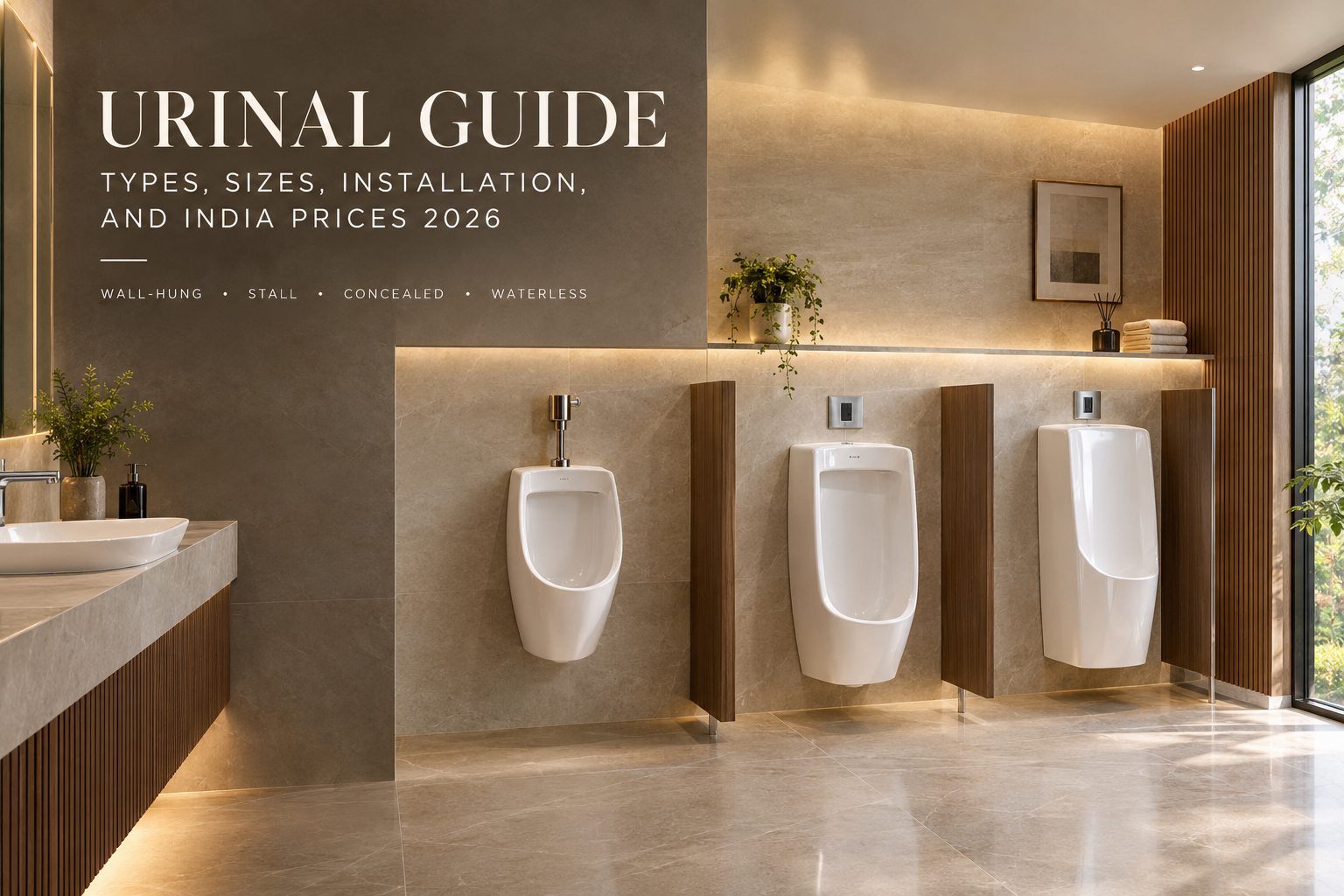



Urinals preserve water, cut back the frequency of bathroom cleansing, and use much less flooring area for the duties they deal with than normal bogs. In Indian residential bogs with two or extra male occupants, putting in a urinal subsequent to the bathroom can cut back bathroom use by 30-40% for that group of occupants. This immediately reduces the cleansing burden and sitting friction that’s acquainted to each family. Industrial bogs (workplaces, eating places, gyms) come normal with urinals. On this information, we’ll clarify how urinals work, what sorts can be found in India, what to examine earlier than putting in them, and the value of high quality urinals in 2026.
What’s a urinal?
A urinal is a wall-mounted sanitary fixture designed particularly for males, related to a chilly water flush provide and a soil pipe. It consists of a ceramic bowl that collects and directs waste to a entice and soil connection under, a flush inlet on the prime or aspect, and a entice and outlet connection on the backside or rear of the bowl.
Take a look at Salus India’s lavatory equipment and sanitary merchandise together with full lavatory becoming merchandise for residential and business bogs in India.
Forms of urinals
normal wall-mounted urinal
The most typical kind in bogs and business institutions in India. Connect the bowl to the wall utilizing hidden brackets or wall mount {hardware}. Drain pipes are related by the wall or below the wall. Accessible in single models and collection for business properties. You will want a wall provide connection for the flashing and a clay pipe on the acceptable peak behind or under the wall.
stall urinal
A big urinal with prolonged aspect wings and longer bowl depth, designed for high-traffic business bogs. Covers a wider space and is much less prone to splatter. Normally present in airports, motels, and huge workplace buildings. It isn’t quite common in residential purposes in India attributable to its measurement.
Hidden water tank urinal (computerized cleansing)
A wall-mounted urinal with a hidden flush tank constructed right into a duct or cavity behind the wall. Self-cleaning mechanisms (sensor-triggered or timed intervals) carry out cleansing with no seen guide deal with. Required in business bogs below the Nationwide Constructing Code Pointers for Public Sanitation Services. Clear look and hands-free operation. Set up prices shall be greater attributable to duct work.
waterless urinal
Urinals with out flush connections. Comprise odors with out water utilizing liquid sealant traps or cartridge inserts. Every unit saves roughly 40,000 to 150,000 liters of water per yr. Relying on utilization, sealant cartridges needs to be changed each 3 to 7 months. It has been adopted in inexperienced constructing tasks and LEED rated buildings in India. It’s nonetheless not frequent in residential bogs in India.
Urinal measurement and peak
Indian normal urinal dimensions:
| measurement | normal vary |
| bowl width | 300~380mm |
| Bowl depth (protrusion) | 280~350mm |
| Bowl peak (whole) | 550~650mm |
| Mounting peak (rim from flooring) | 550-600 mm for adults. Pediatric 350-400mm |
For residential bogs, a normal grownup peak wall-mounted urinal with a width of 330 to 380 mm is appropriate for many Indian lavatory layouts. For kids’s or accessible urinals, the rim peak is decreased to 350-400 mm.
The minimal flooring space in entrance of the urinal shall be 600 mm for snug use and 750 mm for accessible compliance as per Indian Normal IS 3442.
Cleansing quantity and water effectivity
Indian urinals usually flush 1.5 to 2 liters of water per flush. Older fashions flush 4 to six liters of water per flush. In case you are specifying a brand new urinal, please choose the 1.5 liter flush mannequin. That is the usual for BIS licensed urinals and complies with the BEE Water Effectivity Ranking relevant to business tasks.
Sensor-activated flushing methods in business urinals remove water wastage from periodic flushing, the place the tank is flushed no matter whether or not the urinal is used or not.
Set up necessities
The urinal requires:
- Chilly water provide connection (BSP 1/2 inch inlet, Indian normal)
- Earthen pipe connections on the appropriate peak and site behind or under the wall
- Partitions able to bearing mounted masses: Strong masonry or concrete partitions for traditional urinals. Metal framed ducting if utilizing a hid aquarium system
- Applicable floor-to-ceiling peak of the flush tank when floor mounted above the urinal.
The soil pipe needs to be related at or under the urinal entice outlet with out extending the drain pipe upwards. The waste flowing upward from the urinal shouldn’t be eliminated by gravity. In the event you’re including a urinal to your residential lavatory, take a look at our lavatory renovation planning guidelines earlier than the tough implementation stage, as the placement of the clay pipe will decide if it may be put in.
upkeep
All the time flush the urinal after use in a residential setting. In Mumbai’s onerous water, urine scale and limescale construct up on the entice outlet and flush inlet nozzles inside a number of weeks. Take away scale month-to-month utilizing your personal urinal scale remover or a diluted white vinegar answer. constant Bathroom equipment maintenance routine Hold the entice clear and the bowl floor sanitary. As said on this article, a clear and odor-free lavatory is a direct results of the standard of fittings and frequency of upkeep. daily bathroom wellness Let’s talk about.
Urinal Worth Information India 2026
| kind | measurement | Worth (INR) |
| Normal wall mount, guide flush | 330~380mm | ₹3,000 to ₹8,000 |
| Wall-mounted with ISI mark | 330~380mm | ₹5,000 to ₹12,000 |
| stall urinal | 500mm or extra | ₹8,000 to ₹20,000 |
| hidden aquarium auto flush set | 330~380mm | ₹15,000 to ₹40,000 |
| waterless urinal | 330~380mm | ₹8,000 to ₹25,000 |
Set up: ₹3,000 to ₹8,000 for the standard wall-mounted unit with current earth pipe connections. New soil pipes and provide connections: ₹8,000 to ₹20,000 additional.
conclusion
Urinals are a sensible addition to bogs in Indian properties occupied by a couple of man. Please specify the 1.5 liter flush kind, examine the clay pipe place earlier than buying, and set up the grownup rim at 550 to 600 mm. For business bogs, sensor cleansing hid aquarium methods remove the necessity for normal cleansing upkeep. Salus India’s sanitary merchandise embody normal residential measurement wall-mounted urinals for constructing installations in India.
FAQ
Q1. What’s the normal set up peak of urinals in India?
The rim of the grownup urinal needs to be 550-600 mm from the completed flooring degree. For pediatric urinals, decrease the peak to 350-400mm. For accessible urinals as per IS 3442, the rim shall not exceed 430 mm from the completed flooring. The ground area in entrance of the urinal needs to be no less than 600 mm, or 750 mm for straightforward entry.
Q2.Do I want a separate clay pipe for the urinal or can I share the bathroom pipe?
The urinal may be related to the identical soil stack because the WC if the stack is sized appropriately and the urinal outlet is related to or above the WC connection level. Nonetheless, the urinal requires its personal entice and devoted department connection to the chimney. Don’t join urinal waste on to the bathroom pan outlet. This creates a shared entice that permits odor cross-contamination between fittings.
Q3. Why does the urinal scent even after flushing?
If the odor persists after flushing, it normally implies that urine scale has constructed up contained in the entice, making a floor for micro organism to develop and produce odors. Descale the entice month-to-month utilizing your personal urinal scale remover or soaked in white vinegar. In onerous water cities like Mumbai, urolithic scale rapidly combines with limescale. If the odor persists after descaling, the entice could also be partially clogged. Take away and clear or exchange entice insert.
This fall. How a lot water does every urinal use in India?
Fashionable BIS licensed urinals flush between 1.5 and a pair of liters per flush. Older fashions in India have a water capability of 4 to six liters. The sensor-activated system solely flushes the urinal when it’s in use, saving water in comparison with a set interval cistern that flushes each 10 to fifteen minutes no matter use. Waterless urinals remove using flush water, saving between 40,000 and 150,000 liters per yr per unit.
Q5. Can I set up a urinal within the lavatory of a home in India?
sure. There are not any constructing code restrictions on residential urinals in India. The precise necessities are a chilly water provide level, a clay pipe connection on the acceptable peak, and a stable wall to safe the bracket to. A regular 330-380 mm width residential wall-mounted urinal will match right into a small lavatory of 1,500 x 1,500 mm if put in on a separate wall from the bathroom.
Q6. What’s the distinction between an ISI marked urinal and an unbranded urinal?
The ISI mark (IS 2556 Normal, Vitreous Ceramic Sanitary Ware) on a urinal certifies that the ceramic physique, glaze end, water absorption and dimensional tolerances have been examined as per Indian requirements. Off-brand urinals use thinner glassy porcelain with untested glaze high quality, which may trigger floor cracks, stains, and odor retention over time. For residential or business use, all the time select sanitary ware with the ISI mark.
Q7. How usually ought to urinals be descaled in onerous water areas?
Descale residential urinals month-to-month with onerous water in Mumbai. For business urinals which are ceaselessly used, descale them weekly. Use your personal bathroom bowl descaler or diluted white vinegar (1:3 with water), pour it into the bowl and entice, let it sit for 20 to half-hour, then rinse completely. Month-to-month descaling prevents urine and limescale from binding into onerous deposits that require mechanical elimination.